Civil Services Examination · Question 90
Which one of the following statements about Unified Payments Interface (UPI) and Central Bank Digital Currency (Digital Rupee) is not correct ?
Show answer & explanationShow explanation
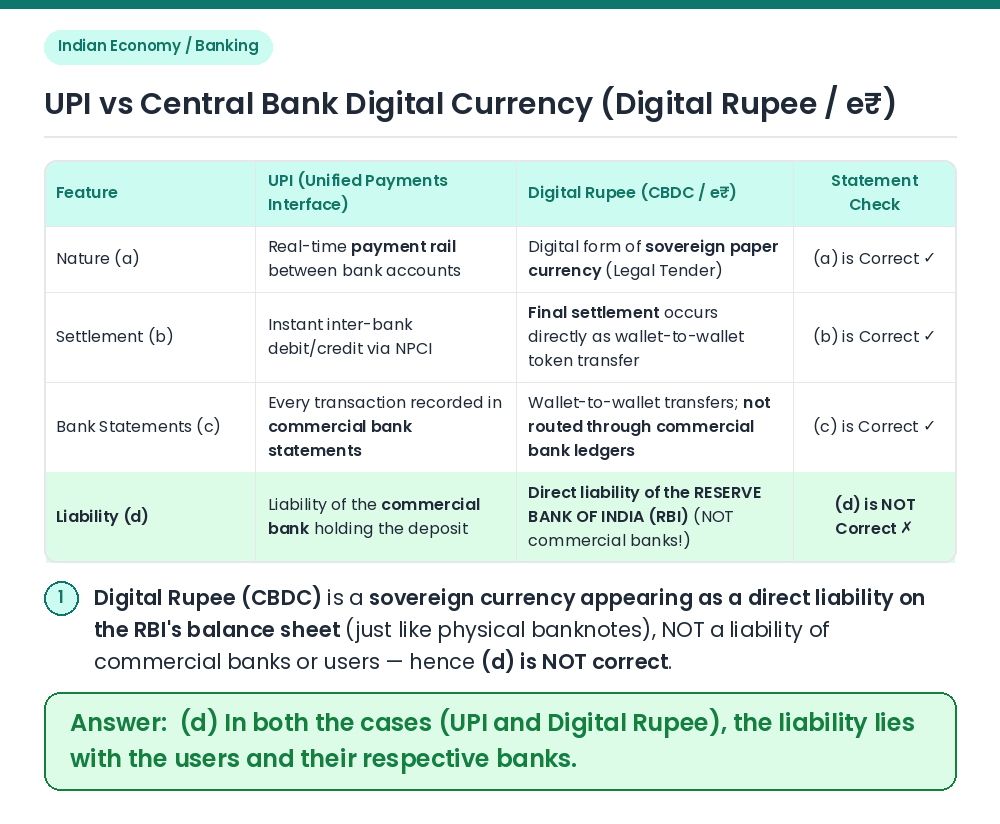
Answer: (D) In both the cases (UPI and Digital Rupee), the liability lies with the users and their respective banks.
Concept: UPI is a payment interface that moves commercial bank deposits between bank accounts, whereas the Digital Rupee (e₹ / CBDC) is legal tender issued in digital token form by the Reserve Bank of India (RBI). Evaluate Options a, b, and c: ⇒ (a) UPI is a real-time payment system while Digital Rupee is digital sovereign currency (correct); (b) in Digital Rupee, transferring the digital token from one CBDC wallet to another IS the final payment itself, requiring no separate inter-bank clearing/settlement (correct); and (c) peer-to-peer CBDC wallet transfers do not clutter commercial bank passbooks/statements the way UPI bank-account debits do (correct). Identify Why Option d is NOT Correct: ⇒ While money transferred via UPI is a commercial bank deposit (a liability of the respective commercial bank), the Digital Rupee (CBDC) is a direct sovereign liability of the Central Bank (RBI) on its balance sheet — commercial banks only act as intermediaries distributing CBDC wallets and carry NO liability for the e₹ itself. Result: Statement (d) is not correct. Related Facts: RBI's Digital Rupee (e₹) Pilots (2022): • Two Variants Launched: Wholesale CBDC (e₹-W, launched Nov 2022 for secondary market government securities settlement) and Retail CBDC (e₹-R, launched Dec 2022 for P2P and P2M transactions). • Statutory Backing: Amended Section 2 of the RBI Act, 1934 (via Finance Act, 2022) expanded the definition of 'bank note' to include notes in digital form. Correct Answer: (d) In both the cases (UPI and Digital Rupee), the liability lies with the users and their respective banks.