Civil Services Examination · Question 94
Which one of the following best describes the 'Crowding Out Effect' in the context of fiscal policy ?
Show answer & explanationShow explanation
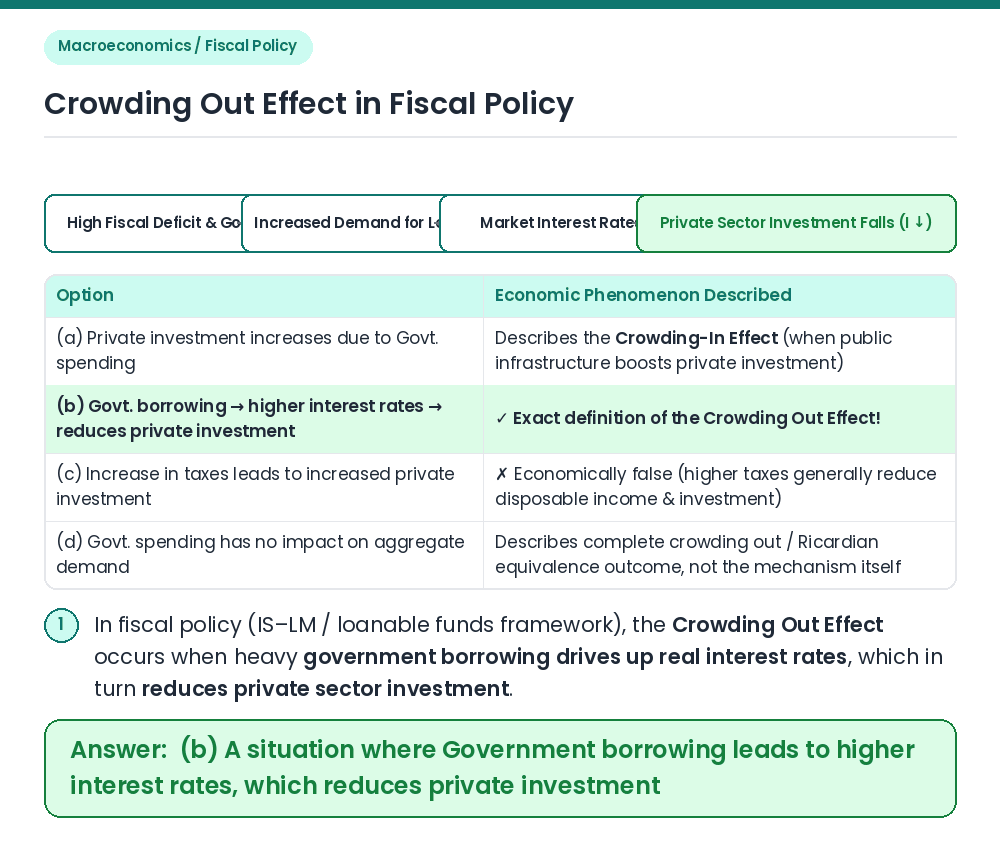
Answer: (B) A situation where Government borrowing leads to higher interest rates, which reduces private investment
Concept: In macroeconomics, expansionary fiscal policy financed by market borrowing competes with the private sector in the loanable funds market. Trace the Mechanism: ⇒ When the Government runs a large fiscal deficit and borrows heavily from the domestic bond market, the demand for loanable funds rises sharply; this pushes up market interest rates, making borrowing costlier for private businesses and thereby reducing ('crowding out') private capital investment. Contrast with Crowding In — Option a: ⇒ Option (a) describes the opposite phenomenon known as the 'Crowding-In Effect' (where productive government capital expenditure on highways, ports, and power stimulates complementary private investment). Result: Option (b) best describes the Crowding Out Effect. Related Facts: Fiscal Responsibility & Crowding Out: • IS–LM Model Representation: Expansionary fiscal policy shifts the IS curve right, raising equilibrium income (Y) and the interest rate (r); the higher interest rate dampens interest-sensitive private investment. • FRBM Act, 2003: Restrains excessive government fiscal deficits in India partly to prevent the crowding out of private corporate investment. Correct Answer: (b) A situation where Government borrowing leads to higher interest rates, which reduces private investment