UP Super TET · Question 54
Disability to read and write is
Show answer & explanationShow explanation
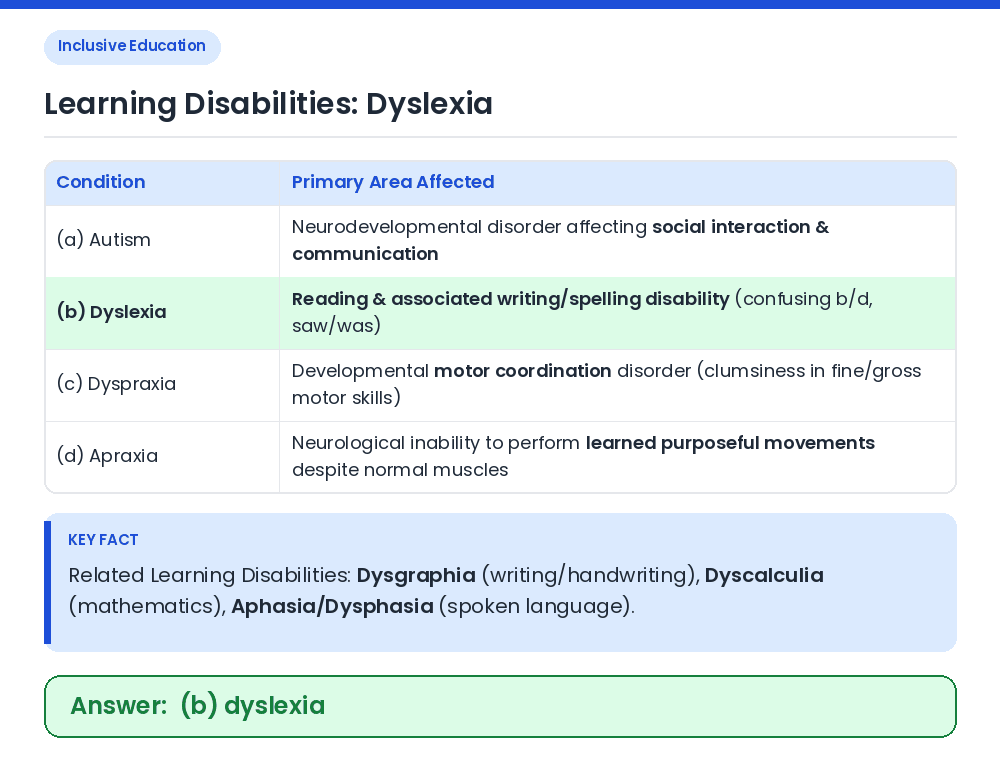
Answer: (B) dyslexia
Dyslexia is a specific learning disability rooted in phonological processing that primarily impairs a child's ability to read and consequently affects spelling and writing. • Children with dyslexia often reverse or confuse similar-looking letters and words (such as 'b' and 'd', 'p' and 'q', or 'saw' and 'was'), leading to difficulties in both reading decoding and written expression. • Notice: While isolated writing impairment is called 'dysgraphia' (not among the options), 'dyslexia' is the standard umbrella answer for reading and writing disability among the given choices. Why other options are wrong: • (a) autism: Autism Spectrum Disorder (ASD) impairs social interaction, communication, and involves repetitive behaviours. • (c) dyspraxia: A developmental coordination disorder affecting physical movement, balance, and fine/gross motor planning. • (d) apraxia: A neurological motor disorder in which a person cannot execute purposeful learned movements on command. Related Facts: • The term 'Dyslexia' was coined in 1887 by German ophthalmologist Rudolf Berlin. • Dysgraphia: Specific learning disability in handwriting and written expression. • Dyscalculia: Specific learning disability in arithmetic and mathematical calculations. • The term 'Learning Disability' was first coined by Samuel Kirk in 1963. Correct Answer: (b) dyslexia