UP Super TET · Question 56
Which Committee in the history of Indian education discussed 'wastage and stagnation' first of all?
Show answer & explanationShow explanation
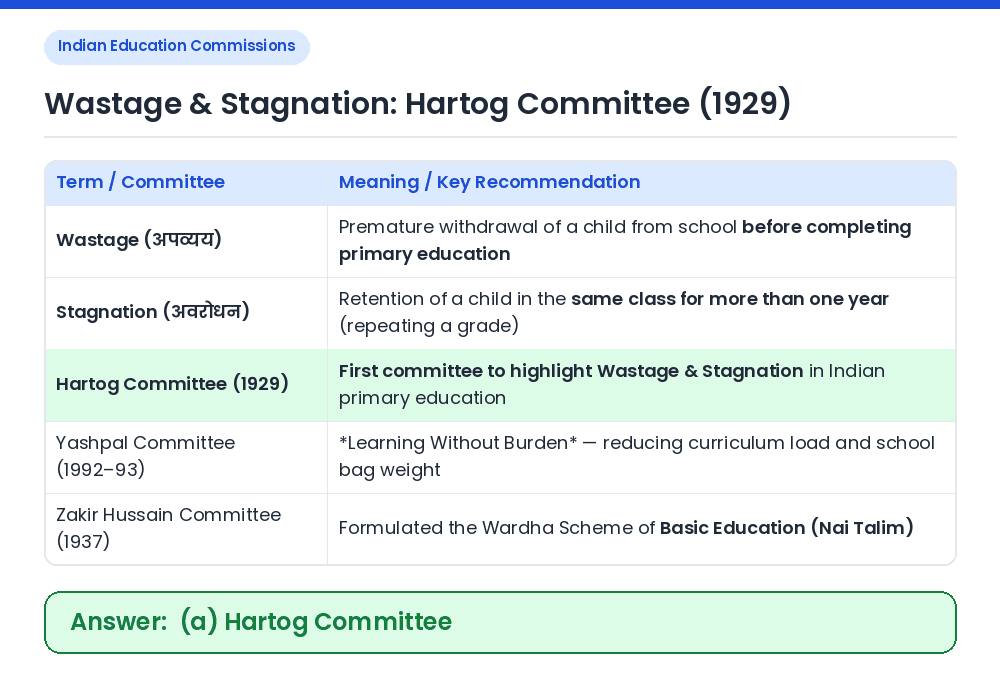
Answer: (A) Hartog Committee
The Hartog Committee (1929), chaired by Sir Philip Hartog as an auxiliary committee of the Simon Commission, was the first in the history of Indian education to systematically examine and define 'wastage and stagnation' in primary education. • It defined 'Wastage' (अपव्यय) as the premature withdrawal of children from school at any stage before the completion of the primary course. • It defined 'Stagnation' (अवरोधन) as the retention of a child in a lower class for a period of more than one year. Why other options are wrong: • (b) Yashpal Committee (1992–93): National Advisory Committee that submitted the report 'Learning Without Burden' (शिक्षा बिना बोझ के) in 1993. • (c) Mehta Committee: Associated with Panchayati Raj (Balwant Rai Mehta 1957 / Ashok Mehta 1977) or Hansa Mehta Committee (1962) on women's education. • (d) Zakir Hussain Committee (1937): Prepared the detailed syllabus for Mahatma Gandhi's Wardha Scheme of Basic Education (Nai Talim). Related Facts: • The Hartog Committee recommended a policy of 'consolidation and qualitative improvement' rather than hasty quantitative expansion of primary schools. • Under Section 16 of the RTE Act 2009 (amended in 2019), no-detention and remedial instruction provisions directly target wastage and stagnation. Correct Answer: (a) Hartog Committee