UP Super TET · Question 57
Absolute zero exists in
Show answer & explanationShow explanation
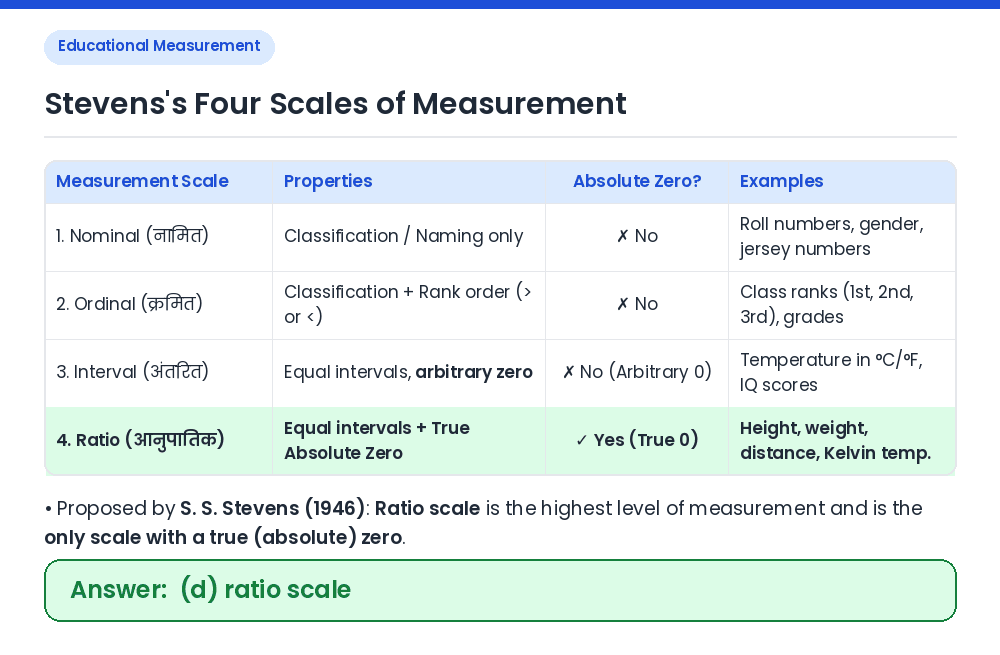
Answer: (D) ratio scale
Absolute (true) zero exists only in the ratio scale, which is the highest and most precise of the four levels of measurement classified by psychologist S. S. Stevens (1946). • In a ratio scale, zero indicates the complete absence of the attribute being measured (e.g., 0 cm length or 0 kg weight means no length or no weight at all). • Because it possesses both equal intervals and a true zero point, all four arithmetic operations (+, −, ×, ÷) and ratio statements ('twice as heavy') are valid on a ratio scale. Why other options are wrong: • (a) nominal scale: Lowest level of measurement; only categorizes or labels objects (e.g., pin codes, gender) with no numerical magnitude. • (b) interval scale: Has equal units between points (e.g., Celsius temperature or educational test scores) but only an arbitrary/relative zero (0 °C does not mean absence of heat). • (c) ordinal scale: Ranks items in order (1st, 2nd, 3rd) without equal intervals or a true zero. Related Facts: • S. S. Stevens introduced the four scales in his 1946 paper 'On the Theory of Scales of Measurement' (mnemonic: NOIR — Nominal, Ordinal, Interval, Ratio). • Most psychological and educational achievement tests operate on the Interval scale because a score of 0 on a test does not mean the student has 'zero knowledge'. Correct Answer: (d) ratio scale