Civil Services Examination · Question 55
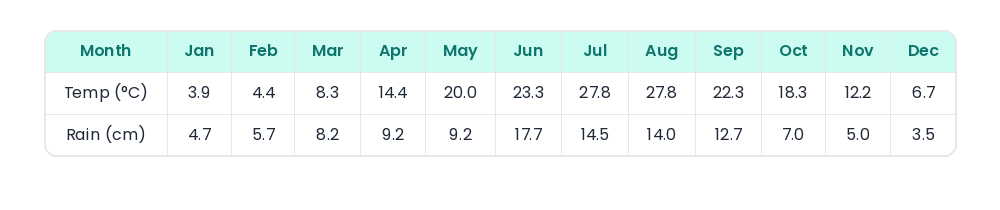
Consider the following climatic conditions (northern hemisphere): Month — Temperature (°C) — Rainfall (cm) January — 3.9 — 4.7 February — 4.4 — 5.7 March — 8.3 — 8.2 April — 14.4 — 9.2 May — 20.0 — 9.2 June — 23.3 — 17.7 July — 27.8 — 14.5 August — 27.8 — 14.0 September — 22.3 — 12.7 October — 18.3 — 7.0 November — 12.2 — 5.0 December — 6.7 — 3.5 These are most likely to be found in the natural regions of:
Show answer & explanationShow explanation
Answer: (A) China type
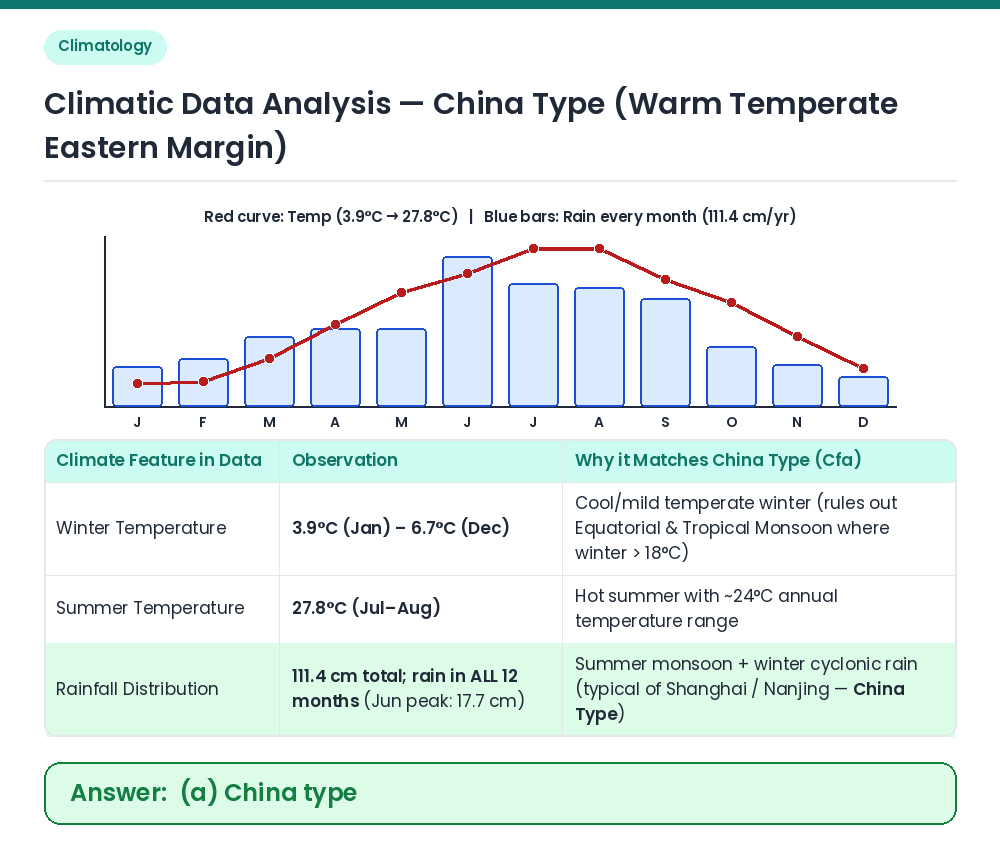
Given / Concept: Analyze the annual temperature range and seasonal rainfall distribution from the 12-month climatic table. Temperature Analysis: Winter temperatures drop to 3.9°C in January and 4.4°C in February, while summer temperatures reach 27.8°C in July–August (annual range = 23.9°C). Such cool winters (below 5°C) immediately rule out Equatorial (uniform ~27°C all year) and tropical Monsoon climates. Rainfall Analysis: Total annual rainfall is 111.4 cm (rules out Hot Desert < 25 cm), with rain occurring in every single month of the year and a pronounced summer maximum (June–September) — the classic signature of the Warm Temperate Eastern Margin ('China type' / Köppen Cfa) climate (e.g., Shanghai). Result: These climatic conditions belong to the China type natural region. Shortcut: Cool winter (3.9°C in Jan) + hot summer (27.8°C in Jul) + year-round rain with a summer peak = China type climate. Correct Answer: (a) China type