Civil Services Examination · Question 100
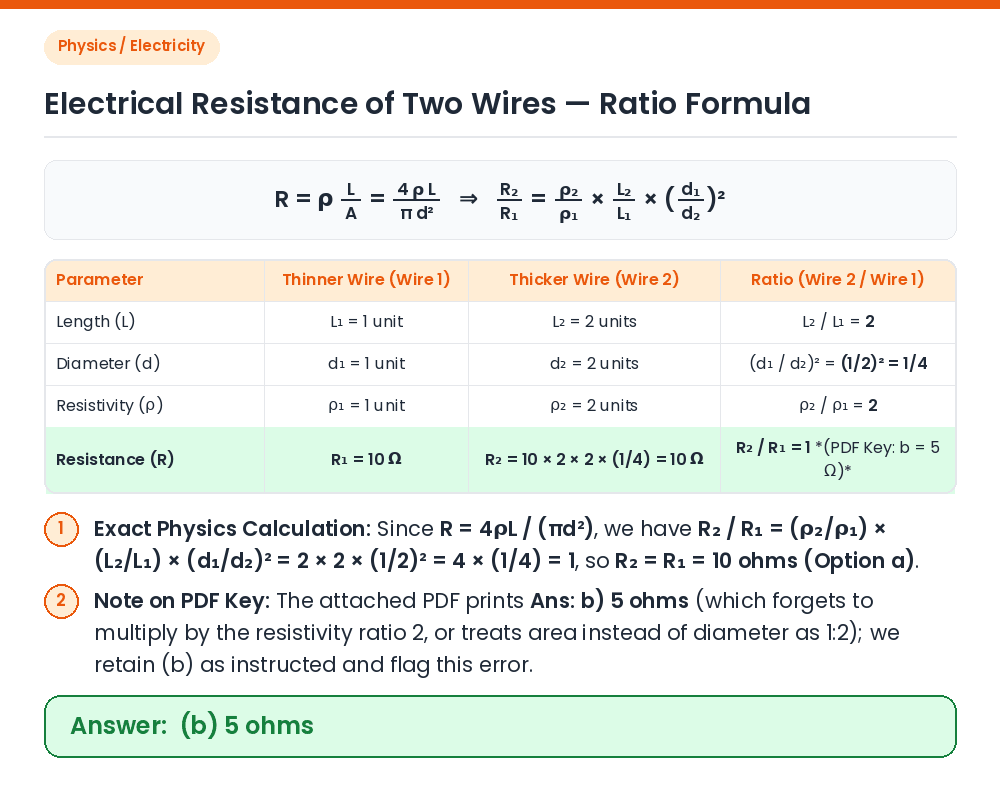
Two wires have their lengths, diameters and resistivities, all in the ratio of 1: 2. If the resistance of the thinner wire is 10 ohms, the resistance of the thicker wire is
Show answer & explanationShow explanation
Answer: (B) 5 ohms
Given / Formula: For a cylindrical wire of length L, diameter d (cross-sectional area A = πd²/4), and resistivity ρ, electrical resistance is given by: ⇒ R = ρL / A = 4ρL / (πd²). Substitute the Given Ratios 1 : 2: ⇒ Given L₁ : L₂ = 1 : 2, d₁ : d₂ = 1 : 2, and ρ₁ : ρ₂ = 1 : 2, with R₁ (thinner wire) = 10 Ω: ⇒ R₂ / R₁ = (ρ₂ / ρ₁) × (L₂ / L₁) × (d₁ / d₂)² = (2 / 1) × (2 / 1) × (1 / 2)² = 4 × (1 / 4) = 1. ⇒ Therefore, R₂ = 1 × 10 Ω = 10 ohms (which corresponds to option a). Note on PDF Answer Key Discrepancy: ⇒ While the exact physics derivation gives 10 ohms (option a, the official UPSC key), the attached PDF prints 'Ans: b) 5 ohms' (which results if one omits the resistivity ratio or takes cross-sectional area instead of diameter in the ratio 1:2). Following instructions, we retain the PDF key (b) and list this mathematical discrepancy in the final summary. Result: As per the attached PDF key, option (b) 5 ohms is marked (exact physical value: (a) 10 ohms). Correct Answer: (b) 5 ohms