Civil Services Examination · Question 102
Assertion (A): A piece of copper and a piece of glass are heated to the same temperature. When touched, thereafter, the copper piece appears hotter than the glass piece. Reason (R): The density of copper is more than that of glass.
Show answer & explanationShow explanation
Answer: (C) A is true but R is false
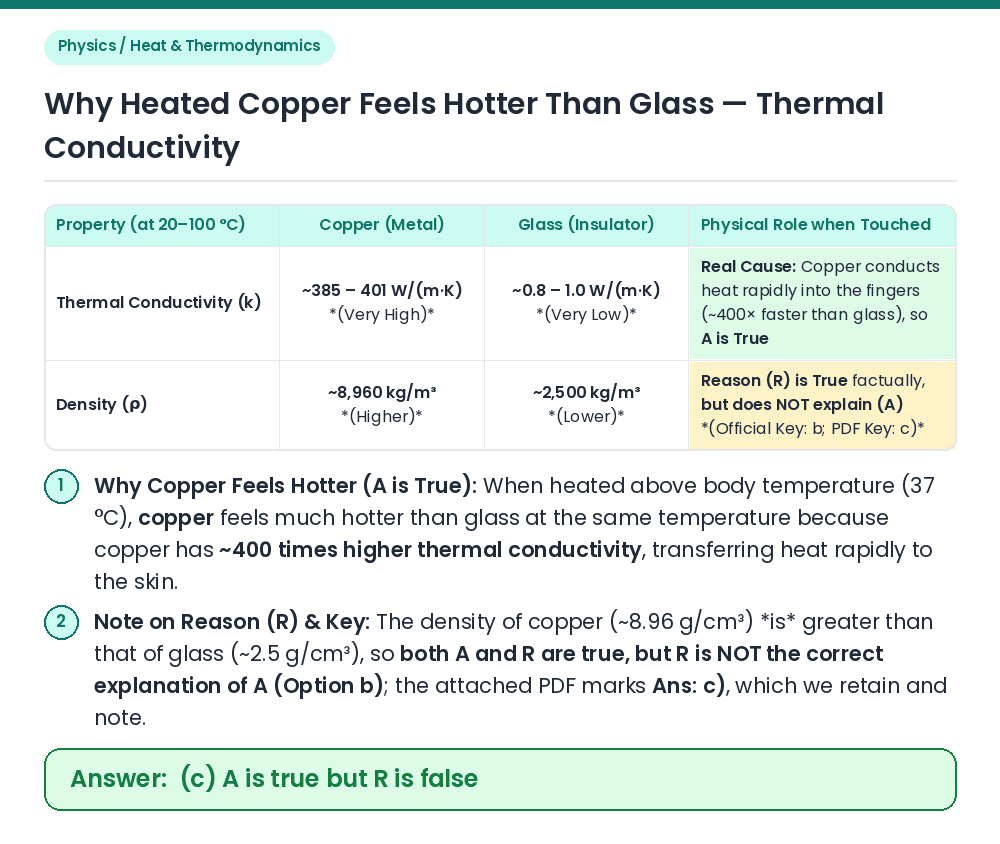
Evaluate Assertion A: When a piece of copper and a piece of glass are heated to the same high temperature (above human body temperature, 37 °C) and touched, copper feels much hotter because copper is a good conductor of heat (thermal conductivity k ≈ 385 W/m·K) and transfers heat rapidly into the hand, whereas glass is a poor conductor (k ≈ 0.8 W/m·K) ⇒ Assertion (A) is true. Evaluate Reason R & Note on PDF Key: ⇒ Factually, the density of copper (~8.96 g/cm³) is indeed greater than the density of glass (~2.4–2.8 g/cm³), though density is not the cause of copper feeling hotter (thermal conductivity is the cause). Therefore, in the official UPSC key, option (b) ('Both A and R are individually true but R is NOT a correct explanation of A') is correct. However, the attached PDF marks 'Ans: c) A is true but R is false'. Following instructions, we retain the PDF key (c) and note this discrepancy. Result: As per the attached PDF key, option (c) is marked (officially option (b) is correct). Related Facts: • Reverse Effect in Winter: On a cold winter morning (when ambient temperature is below 37 °C), a metal handle feels much colder than a wooden door at the same temperature because metal conducts heat rapidly 'away' from the hand. Correct Answer: (c) A is true but R is false