Civil Services Examination · Question 105
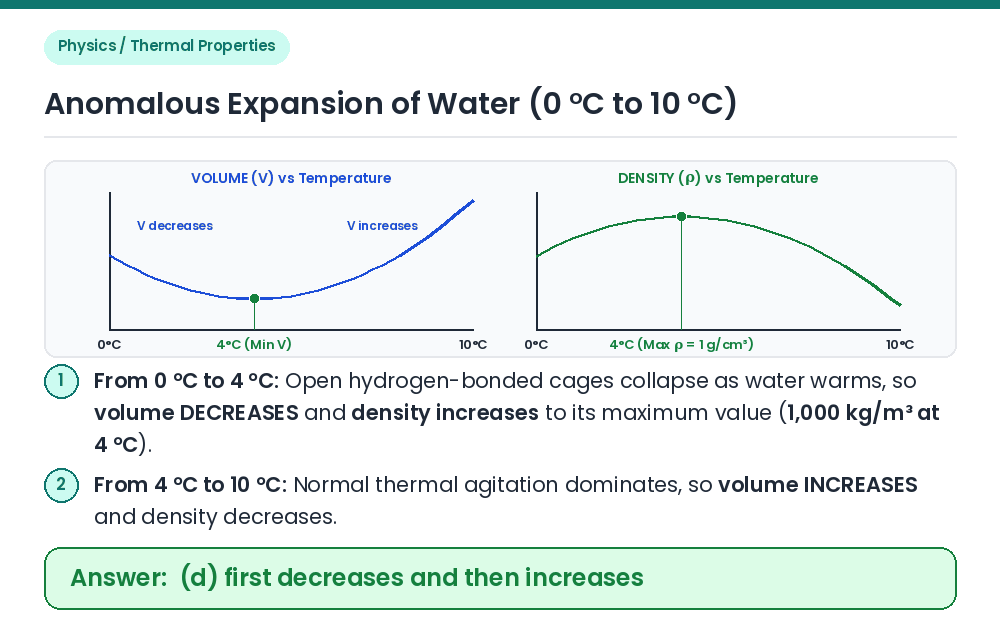
When water is heated from 0°C to 10°C, its volume
Show answer & explanationShow explanation
Answer: (D) first decreases and then increases
Concept — Anomalous Expansion of Water: Unlike most liquids (which expand continuously on heating), water exhibits anomalous behaviour between 0 °C and 4 °C due to hydrogen bonding. Trace Volume from 0 °C to 4 °C and 4 °C to 10 °C: ⇒ (i) From 0 °C to 4 °C: As water is heated, open tetrahedral hydrogen-bonded clusters collapse, causing water to contract — so its volume decreases and its density increases, reaching a minimum volume (and maximum density of 1.000 g/cm³) at 4 °C. ⇒ (ii) From 4 °C to 10 °C: Ordinary thermal kinetic expansion dominates, so its volume increases and its density decreases. Result: When water is heated from 0°C to 10°C, its volume first decreases (up to 4°C) and then increases (from 4°C to 10°C). Related Facts: • Ecological Significance for Aquatic Life: In winter, when surface water cools to 4 °C, it sinks to the bottom while colder water (0 °C to 3 °C) and ice (density 0.917 g/cm³) stay on top, insulating aquatic life in frozen lakes. Correct Answer: (d) first decreases and then increases