Civil Services Examination · Question 120
An aqueous solution of copper sulphate is acidic in nature because the salt undergoes
Show answer & explanationShow explanation
Answer: (C) hydrolysis
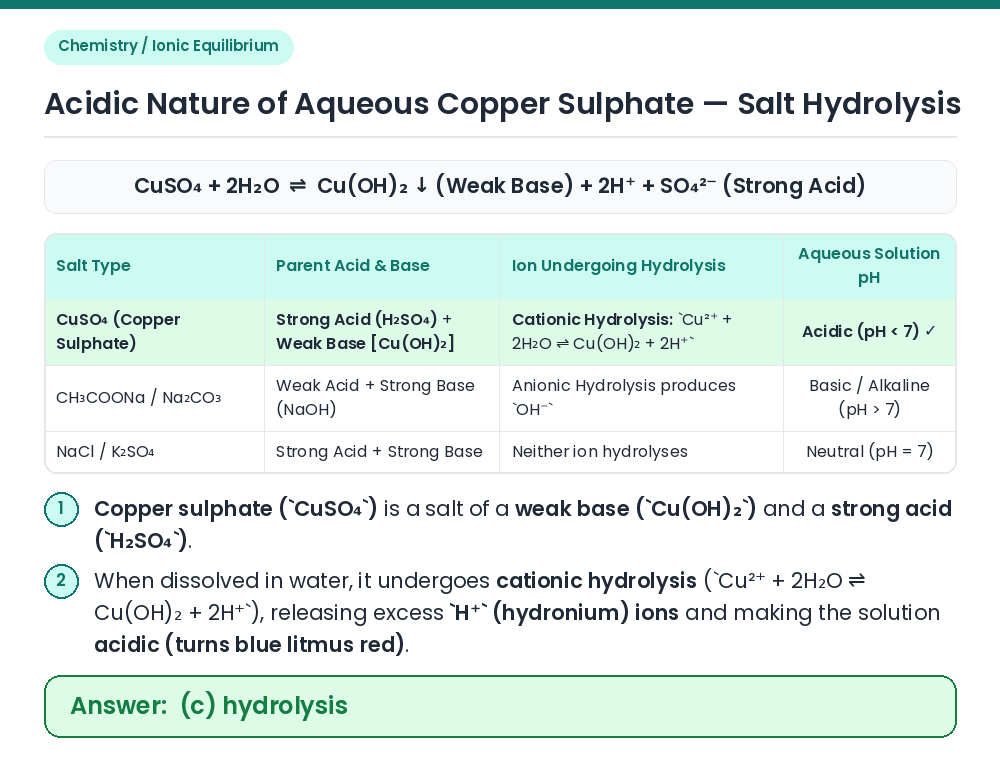
Concept: Copper(II) sulphate (CuSO₄) is a salt formed from a weak base, copper(II) hydroxide [Cu(OH)₂], and a strong acid, sulphuric acid (H₂SO₄). Write the Hydrolysis Reaction: ⇒ When CuSO₄ dissolves in water, the sulphate ion (SO₄²⁻, from strong acid H₂SO₄) remains spectator, while the hydrated cupric cation (Cu²⁺) reacts with water (cationic hydrolysis): ⇒ Cu²⁺(aq) + 2H₂O(l) ⇌ Cu(OH)₂(aq) + 2H⁺(aq). ⇒ The release of free H⁺ (H₃O⁺) ions creates an excess of hydrogen ions over hydroxide ions, making the aqueous solution acidic (pH < 7). Eliminate Other Terms: ⇒ Dialysis is colloidal purification through a semipermeable membrane; electrolysis is decomposition by electric current; photolysis is decomposition by light. Result: An aqueous solution of copper sulphate is acidic because the salt undergoes hydrolysis. Related Facts: • Other Acidic Salts by Cationic Hydrolysis: Ammonium chloride (NH₄Cl), Ferric chloride (FeCl₃), and Aluminium chloride (AlCl₃) all form acidic aqueous solutions. Correct Answer: (c) hydrolysis