Civil Services Examination · Question 73
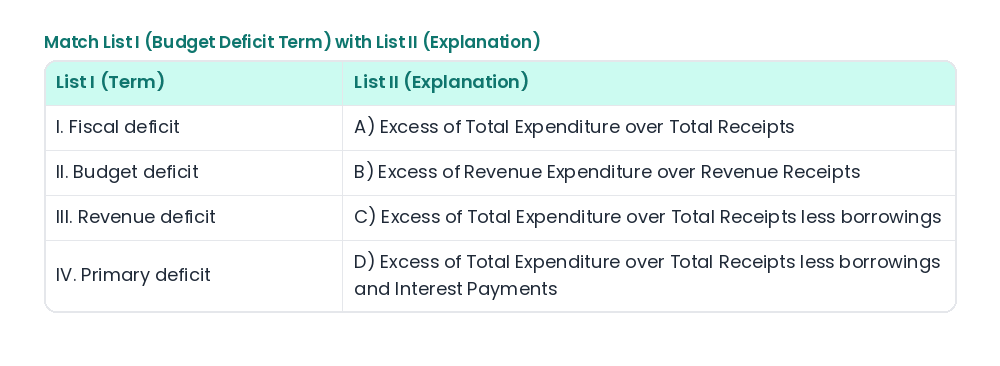
Match List I with List II and select the correct answer using the codes given below the Lists: List I (Term) — List II (Explanation) I. Fiscal deficit — A) Excess of Total Expenditure over Total Receipts II. Budget deficit — B) Excess of Revenue Expenditure over Revenue Receipts III. Revenue deficit — C) Excess of Total Expenditure over Total Receipts less borrowings IV. Primary deficit — D) Excess of Total Expenditure over Total Receipts less borrowings and Interest Payments Codes:
Show answer & explanationShow explanation
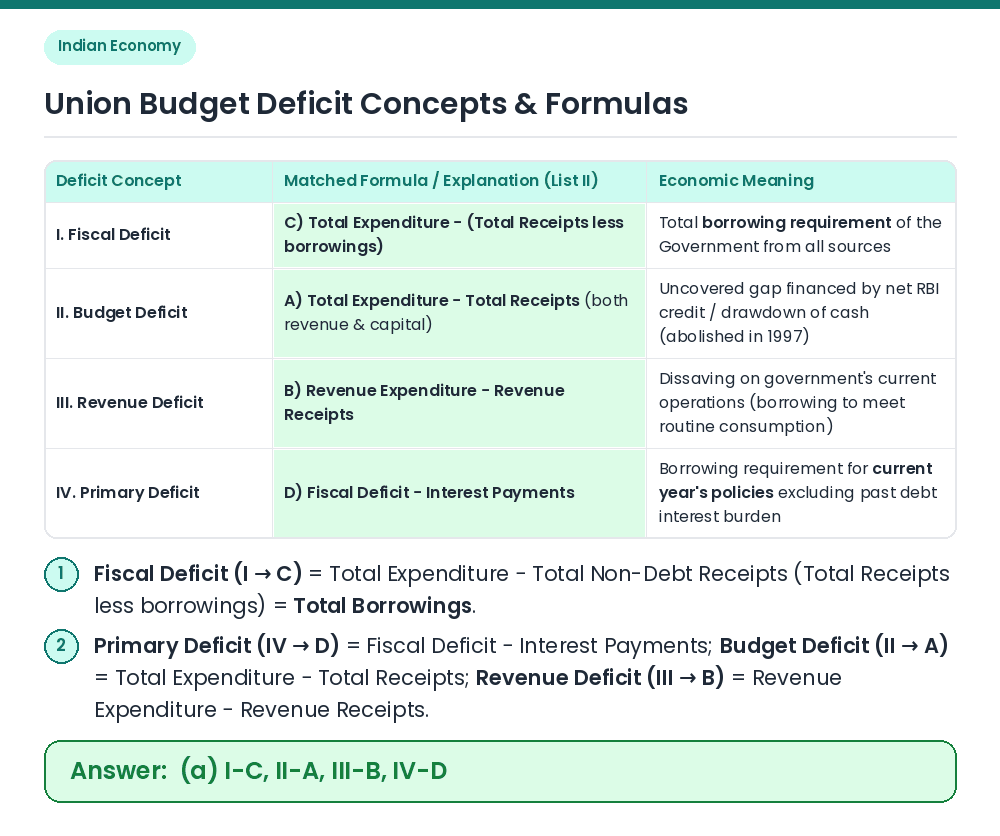
Answer: (A) I-C, II-A, III-B, IV-D
Match I — Fiscal Deficit: Fiscal Deficit is the excess of Total Expenditure (Revenue + Capital) over Total Non-Debt Receipts (i.e., Total Receipts excluding borrowings) ⇒ I matches C. Match II & III — Budget & Revenue Deficit: ⇒ Traditional Budget Deficit is the excess of Total Expenditure over Total Receipts (including borrowings) ⇒ II matches A. Revenue Deficit is the excess of Revenue Expenditure over Revenue Receipts ⇒ III matches B. Match IV — Primary Deficit: ⇒ Primary Deficit equals Fiscal Deficit minus Interest Payments, which is the excess of Total Expenditure over Total Receipts less borrowings and less Interest Payments ⇒ IV matches D. Result: The correct code is I-C, II-A, III-B, IV-D. Related Facts: • Effective Revenue Deficit: Introduced in Union Budget 2011–12 on the recommendation of the Rangarajan Committee; equals Revenue Deficit minus Grants for Creation of Capital Assets. • Abolition of Ad-hoc T-Bills (1997): Following the 1997 supplemental agreement between the Government and RBI, the practice of automatic monetisation of the Budget Deficit was replaced by Ways and Means Advances (WMA). Correct Answer: (a) I-C, II-A, III-B, IV-D