Civil Services Examination · Question 108
Indiscriminate disposal of used fluorescent electric lamps causes mercury pollution in the environment. Why is mercury used in the manufacture of these lamps?
Show answer & explanationShow explanation
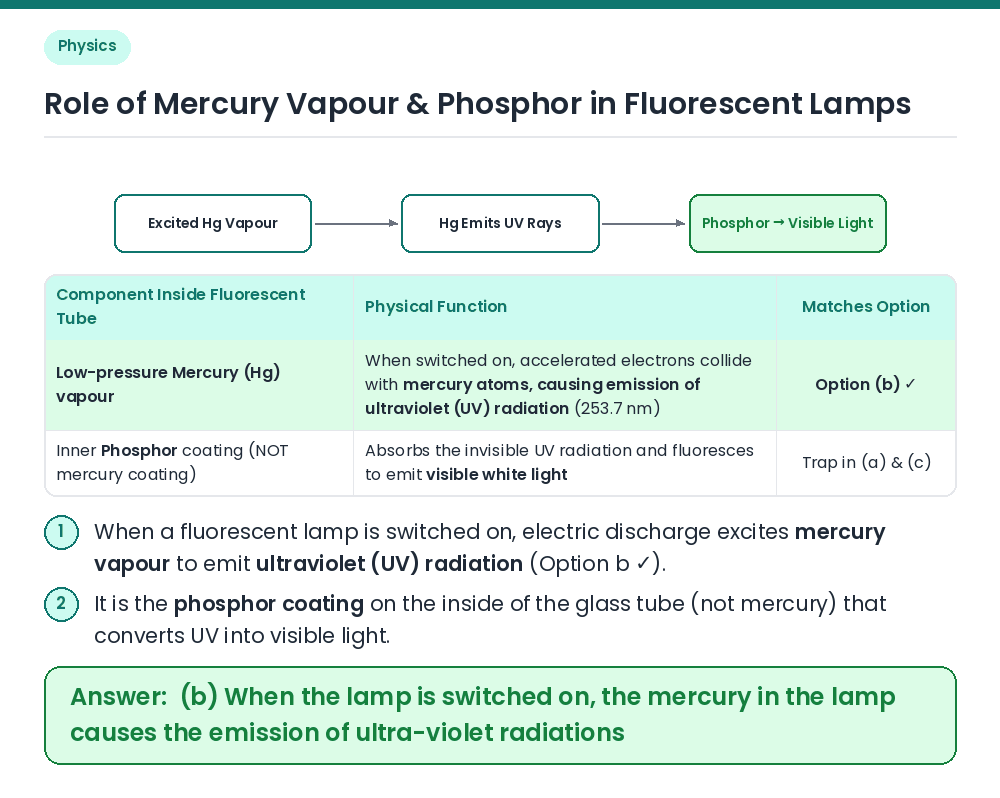
Answer: (B) When the lamp is switched on, the mercury in the lamp causes the emission of ultra-violet radiations
Concept: A fluorescent lamp (or CFL) is a low-pressure mercury-vapour gas-discharge lamp filled with argon gas and a tiny amount of mercury. Two-Step Light Emission: Step A — When the lamp is switched on, an electric current passes through the gas, and free electrons collide with mercury vapour atoms, exciting them so that they emit short-wave ultraviolet (UV) radiation (Option b is correct). Step B — The inner glass wall is coated with a fluorescent 'phosphor' powder (not mercury), which absorbs the UV photons and re-emits visible white light (making Options a and c false). Result: Option (b) is correct. Related Facts: • Minamata Convention on Mercury (adopted in 2013, entered into force in 2017; ratified by India in 2018) is a global treaty to protect human health and the environment from anthropogenic mercury emissions. • Solid-state LED (Light Emitting Diode) lamps contain zero mercury and consume ~50% less energy than CFLs. Correct Answer: (b) When the lamp is switched on, the mercury in the lamp causes the emission of ultra-violet radiations