Civil Services Examination · Question 109
If there were no Himalayan ranges, what would have been the most likely geographical impact on India? 1. Much of the country would experience the cold waves from Siberia. 2. Indo-gangetic plain would be devoid of such extensive alluvial soils. 3. The pattern of monsoon would be different from what it is at present. Which of the statements given above is/are correct?
Show answer & explanationShow explanation
Answer: (D) 1, 2 and 3
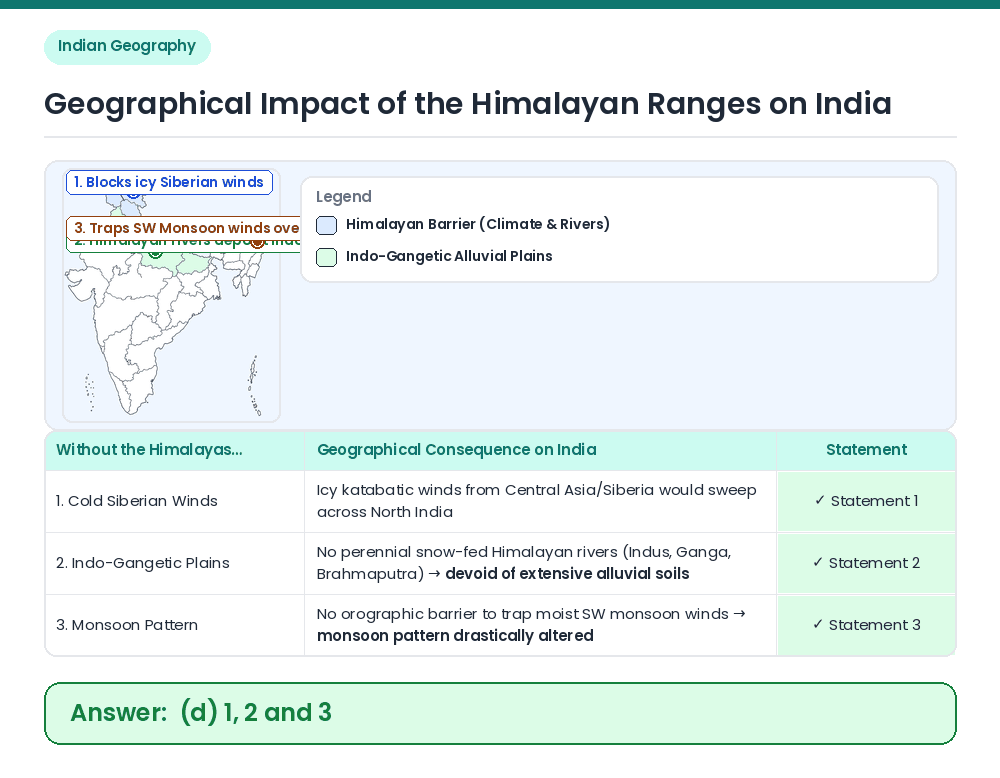
Check Statement 1 — Climatic Shield: The lofty Himalayan range acts as an insurmountable climatic barrier blocking the frigid, dry polar winds blowing southwards from Siberia and Central Asia; without it, North India would experience severe cold waves and desert-like continental winters ⇒ Statement 1 is correct. Check Statement 2 — Alluvial Deposition: The vast, deep alluvial soils of the Indo-Gangetic-Brahmaputra plain were formed by silt eroded and deposited over millions of years by the Himalayan rivers; without the Himalayas, these extensive alluvial plains would not exist ⇒ Statement 2 is correct. Check Statement 3 — Monsoon Dynamics: The Himalayas intercept the moisture-laden Southwest Monsoon winds (forcing orographic rainfall across India) and split the subtropical westerly jet stream; without them, the monsoon pattern would be completely different ⇒ Statement 3 is correct. Result: All three statements 1, 2 and 3 are correct. Related Facts: • The Himalayas are young fold mountains formed by the Cenozoic continent–continent collision of the Indian Plate with the Eurasian Plate (closing the Tethys Sea). Correct Answer: (d) 1, 2 and 3