Civil Services Examination · Question 39
Examine the following statements: 1. I watch TV only if I am bored. 2. I am never bored when I have my brother's company. 3. Whenever I go to the theatre I take my brother along. Which one of the following conclusions is valid in the context of the above statements?
Show answer & explanationShow explanation
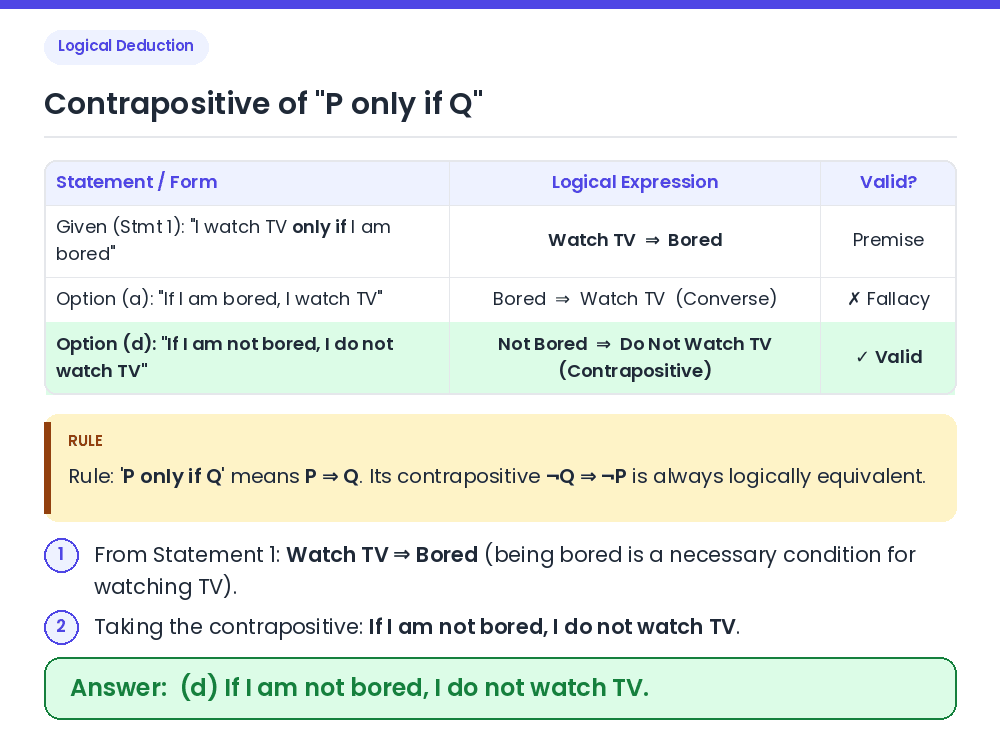
Answer: (D) If I am not bored, I do not watch TV.
Given: Statement 1 says 'I watch TV only if I am bored', which in formal logic means: Watch TV ⇒ Bored. Apply Contrapositive Rule: Every conditional statement (P ⇒ Q) is logically equivalent to its contrapositive (¬Q ⇒ ¬P) ⇒ Not Bored ⇒ Do Not Watch TV. Why Other Options Fail: Option (a) is the converse (Bored ⇒ Watch TV), which is invalid because one can be bored without watching TV; options (b) and (c) also commit logical fallacies. Result: If I am not bored, I do not watch TV. Correct Answer: (d) If I am not bored, I do not watch TV.