Civil Services Examination · Question 12
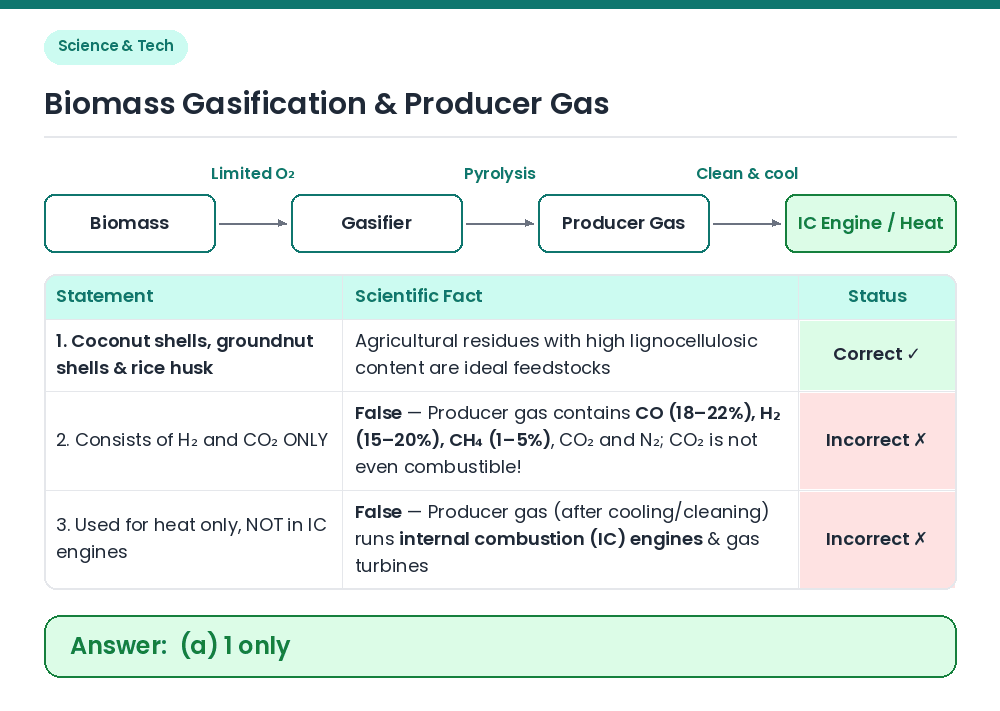
Biomass gasification is considered to be one of the sustainable solutions to the power crisis in India. In this context, which of the following statements is/are correct? 1. Coconut shells, groundnut shells and rice husk can be used in biomass gasification. 2. The combustible gases generated from biomass gasification consist of hydrogen and carbon dioxide only. 3. The combustible gases generated from biomass gasification can be used for direct heat generation but not in internal combustion engines. Select the correct answer using the codes given below :
Show answer & explanationShow explanation
Answer: (A) 1 only
Given / Concept: Biomass gasification is a thermochemical process that converts solid biomass into a combustible gas mixture (Producer Gas / Syngas) under controlled air/oxygen supply. Statement 1 Analysis: Agro-residues such as coconut shells, groundnut shells, rice husk, wood chips, and bagasse are widely used feedstocks in biomass gasifiers ⇒ Statement 1 is correct. Statement 2 Analysis: Producer gas consists of combustible gases—carbon monoxide (CO), hydrogen (H₂), and methane (CH₄)—along with non-combustible nitrogen (N₂) and carbon dioxide (CO₂) ⇒ Statement 2 is incorrect. Statement 3 Analysis: Cleaned producer gas can be used both for direct thermal heating and as fuel in internal combustion (IC) engines (diesel dual-fuel or 100% gas engines) to generate electricity ⇒ Statement 3 is incorrect. Result: Only statement 1 is correct. Related Facts: Key facts about Biomass Gasification: • Producer Gas Composition: Roughly 18–22% CO, 15–20% H₂, 1–5% CH₄, 8–12% CO₂, and 45–55% N₂. • Stages in a Gasifier: Drying (100–200°C) → Pyrolysis (200–600°C) → Oxidation/Combustion (900–1200°C) → Reduction (600–900°C). • Carbon Neutrality: Biomass gasification is considered carbon-neutral because the CO₂ released equals that absorbed during plant growth. Correct Answer: (a) 1 only