Civil Services Examination · Question 13
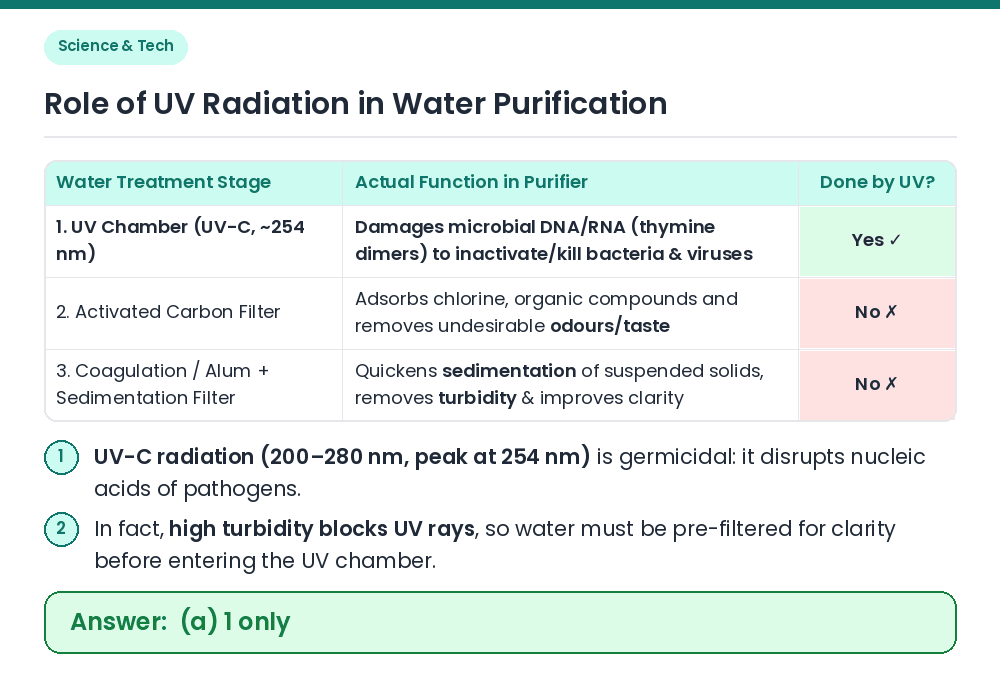
What is the role of ultraviolet (UV) radiation in the water purification systems? 1. It inactivates/kills the harmful microorganisms in water. 2. It removes all the undesirable odours from the water. 3. It quickens the sedimentation of solid particles, removes turbidity and improves the clarity of water. Which of the statements given above is/are correct?
Show answer & explanationShow explanation
Answer: (A) 1 only
Given / Concept: Ultraviolet (UV-C, ~254 nm) radiation is a physical disinfection method used in water purifiers. Statement 1 Analysis: UV radiation penetrates the cell walls of bacteria, viruses, and protozoa and damages their DNA/RNA (forming pyrimidine dimers), preventing replication and inactivating/killing them ⇒ Statement 1 is correct. Statement 2 & 3 Analysis: Undesirable odours are removed by activated carbon filters (2), while sedimentation and turbidity removal are achieved by coagulants (like alum) and mechanical sediment filters (3) ⇒ Statements 2 and 3 are incorrect. Result: Only statement 1 correctly describes the role of UV radiation. Related Facts: Key facts about UV Water Disinfection: • UV Spectrum Bands: UV-A (315–400 nm), UV-B (280–315 nm), and germicidal UV-C (100–280 nm). • Clarity Requirement: Turbid water shields microbes from UV light, so pre-filtration of suspended solids is required before UV treatment. • Zero Chemical Residue: Unlike chlorination, UV disinfection adds no taste, odour, or disinfection by-products (DBPs) to water. Correct Answer: (a) 1 only