Civil Services Examination · Question 15
Lead, ingested or inhaled, is a health hazard. After the addition of lead to petrol has been banned, what still are the sources of lead poisoning? 1. Smelting units 2. Pens and pencils 3. Paints 4. Hair oils and cosmetics Select the correct answer using the codes given below :
Show answer & explanationShow explanation
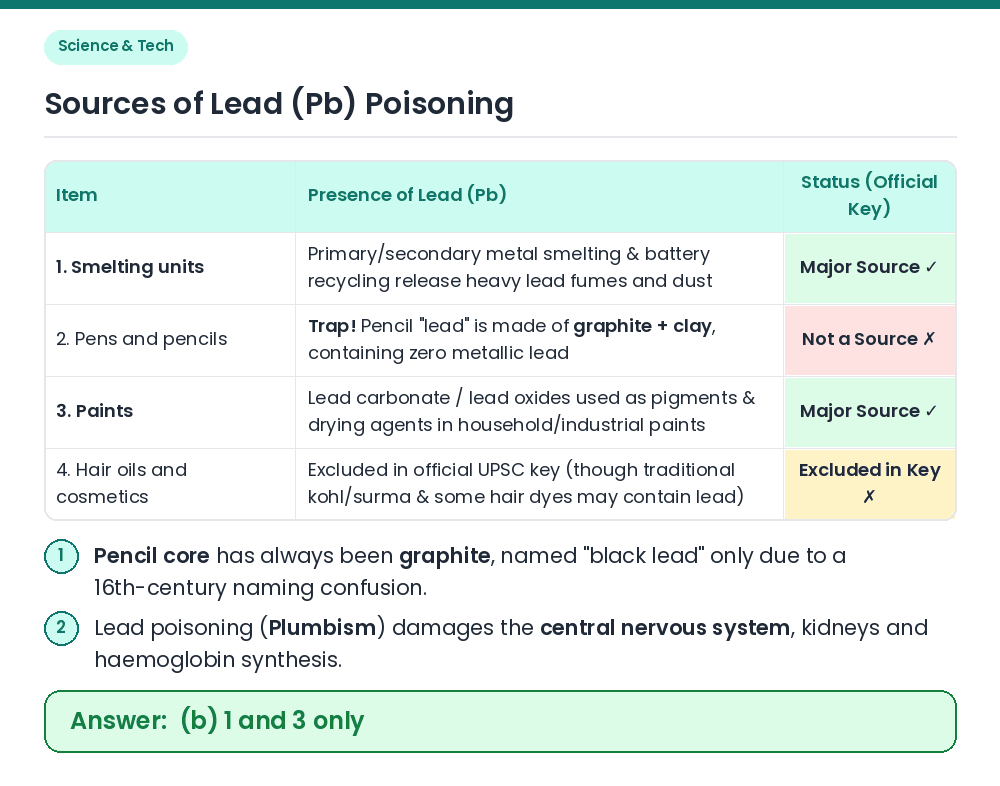
Answer: (B) 1 and 3 only
Given / Concept: After phasing out tetraethyl lead from petrol (completed in India in 2000), industrial and household products remain key sources of lead poisoning (plumbism). Statement 2 Elimination: Pencil 'lead' is actually a mixture of non-toxic graphite (carbon) and clay, not metallic lead ⇒ Eliminating 2 rules out options (a), (c), and (d) directly. Statement 1 & 3 Analysis: Metal smelting/lead-acid battery recycling units (1) and lead-based pigments in paints (3) are major established sources of lead exposure ⇒ 1 and 3 are correct. Result: While certain traditional cosmetics (like kohl/surma and lead-acetate hair dyes) can contain lead, there is no option for '1, 3 and 4', so option (b) 1 and 3 only is the official UPSC key. Related Facts: Key facts about Lead Toxicity: • Health Impact: Lead is a cumulative neurotoxin that inhibits delta-aminolevulinic acid dehydratase (ALAD), causing anaemia and irreversible brain/nervous system damage in children. • BIS Regulation: India enforces a limit of 90 ppm lead in household and decorative paints. • Tetraethyl Lead (TEL): Previously used as an anti-knocking agent in petrol before being banned globally. Correct Answer: (b) 1 and 3 only