Civil Services Examination · Question 18
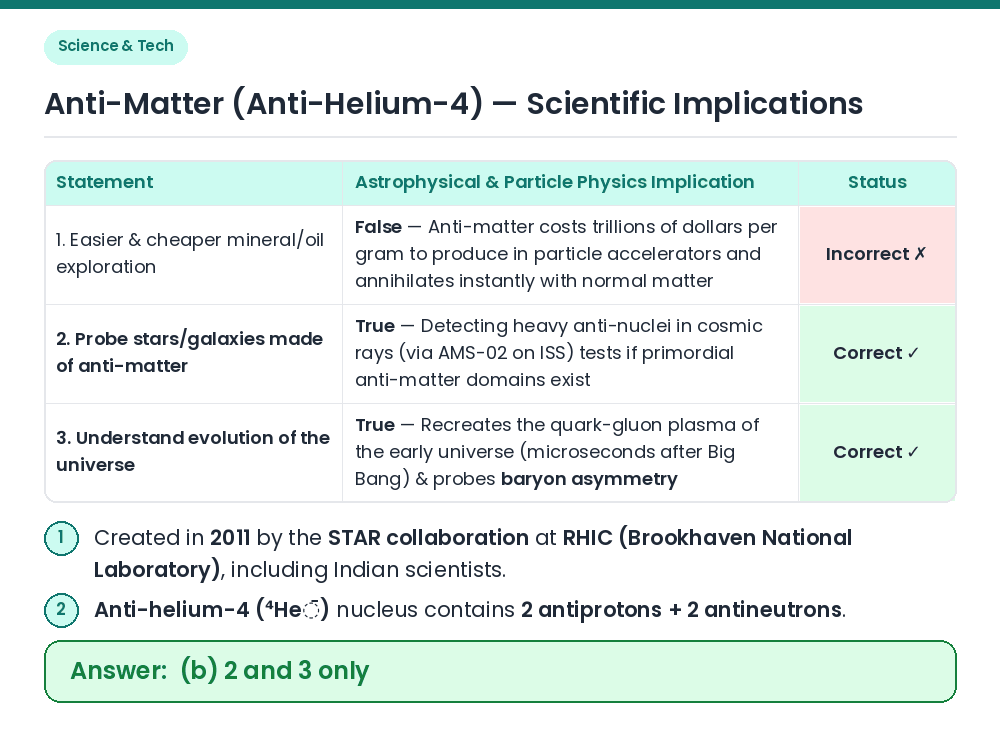
A team of scientists at Brookhaven National Laboratory including those from India created the heaviest anti-matter (anti-helium nucleus). What is/are the implication/implications of the creation of anti-matter? 1. It will make mineral prospecting and oil exploration easier and cheaper. 2. It will help probe the possibility of the existence of stars and galaxies made of anti-matter. 3. It will help understand the evolution of the universe. Select the correct answer using the codes given below :
Show answer & explanationShow explanation
Answer: (B) 2 and 3 only
Given / Concept: In 2011, scientists at the Relativistic Heavy Ion Collider (RHIC) at Brookhaven National Laboratory detected the anti-helium-4 nucleus (2 antiprotons + 2 antineutrons), the heaviest antimatter nucleus observed at that time. Statement 1 Analysis: Producing antimatter requires giant particle colliders, consumes enormous energy, and annihilates on contact with ordinary matter, so it cannot make mineral or oil exploration cheaper ⇒ Statement 1 is incorrect. Statement 2 & 3 Analysis: Measuring the production rate of anti-helium in colliders helps astrophysicists interpret space-based cosmic-ray experiments (like AMS-02) searching for anti-stars/anti-galaxies (2) and understand matter-antimatter asymmetry during the early evolution of the universe after the Big Bang (3) ⇒ Statements 2 and 3 are correct. Result: Statements 2 and 3 only are correct. Related Facts: Key facts about Antimatter Physics: • Annihilation: When a particle and its antiparticle (e.g., electron and positron) meet, they annihilate into pure energy according to E = mc². • Baryon Asymmetry Problem: The Big Bang should have created equal amounts of matter and antimatter; why the observable universe is dominated by matter remains a fundamental question in cosmology. • Practical Medical Use: Positron-emitting isotopes are used in PET (Positron Emission Tomography) medical imaging scans. Correct Answer: (b) 2 and 3 only