Civil Services Examination · Question 19
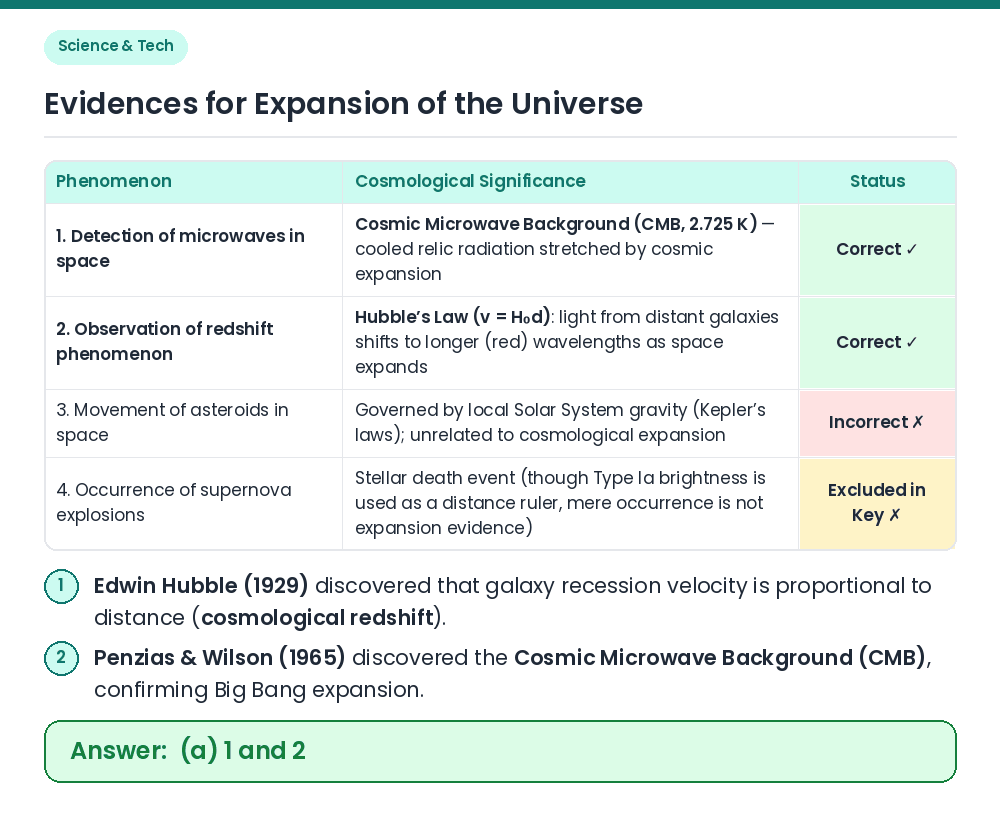
Which of the following is/are cited by the scientists as evidence/evidences for the continued expansion of universe? 1. Detection of microwaves in space 2. Observation of redshift phenomenon in space 3. Movement of asteroids in space 4. Occurrence of supernova explosions in space Select the correct answer using the codes given below :
Show answer & explanationShow explanation
Answer: (A) 1 and 2
Given / Concept: The Big Bang and expanding universe model rests on two primary observational pillars: cosmological redshift and the Cosmic Microwave Background (CMB). Statement 2 Analysis: Light from distant galaxies shows a shift toward longer (red) wavelengths (cosmological redshift), proving that galaxies are receding from one another as space expands ⇒ Statement 2 is correct. Statement 1 Analysis: The detection of uniform microwave radiation in space (Cosmic Microwave Background at ~2.725 K) represents primordial radiation whose wavelength stretched into the microwave region as the universe expanded ⇒ Statement 1 is correct. Statements 3 & 4 Analysis: Asteroid movement is local orbital mechanics under solar gravity (3). While Type Ia supernovae serve as 'standard candles' to measure redshift/accelerated expansion, the mere occurrence of supernova explosions (4) is stellar evolution, so UPSC's official key selects 1 and 2. Result: Statements 1 and 2 are the correct evidences. Related Facts: Key milestones in Cosmology: • Hubble's Law (1929): Recession velocity v = H₀ × d, where H₀ is the Hubble constant. • CMB Discovery (1965): Arno Penzias and Robert Wilson discovered the Cosmic Microwave Background (Nobel Prize 1978). • 2011 Physics Nobel Prize: Awarded to Saul Perlmutter, Brian Schmidt, and Adam Riess for discovering the accelerating expansion of the universe via distant Type Ia supernovae. Correct Answer: (a) 1 and 2