Civil Services Examination · Question 22
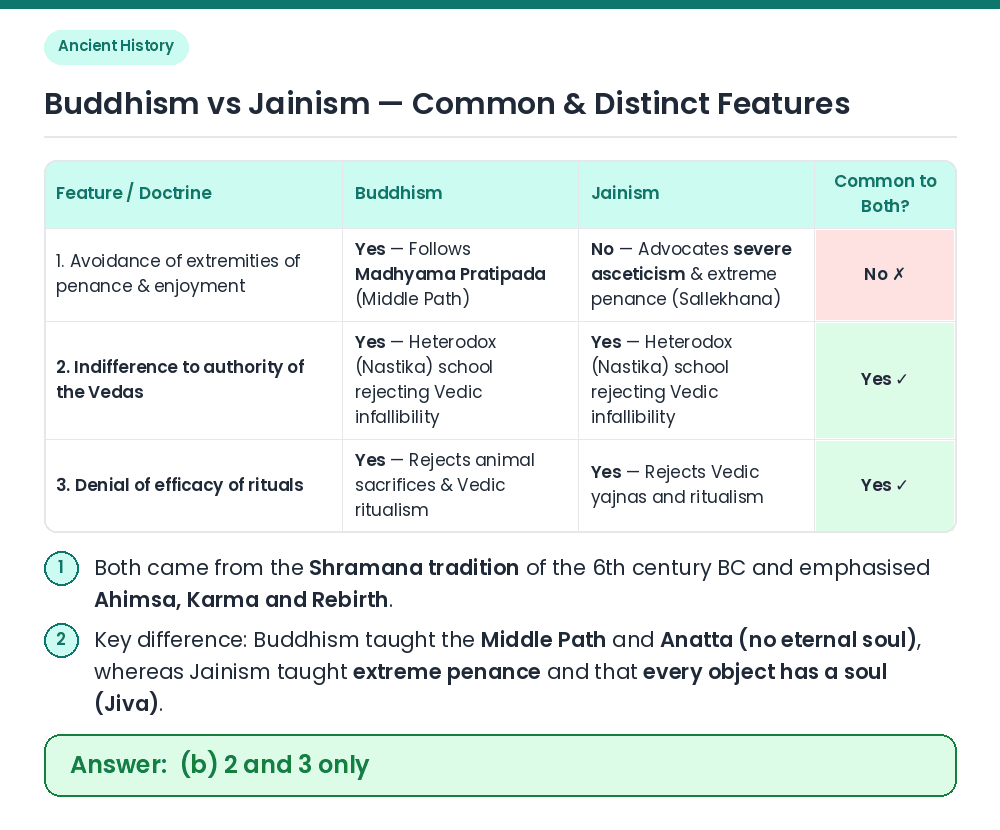
With reference to the history of ancient India, which of the following was/were common to both Buddhism and Jainism? 1. Avoidance of extremities of penance and enjoyment 2. Indifference to the authority of the Vedas 3. Denial of efficacy of rituals Select the correct answer using the codes given below :
Show answer & explanationShow explanation
Answer: (B) 2 and 3 only
Given / Concept: Buddhism and Jainism emerged in the 6th century BC as Shramana (heterodox) movements challenging Brahmanical orthodoxy. Statement 1 Analysis: Avoiding the extremes of severe penance (self-mortification) and sensual indulgence is the 'Middle Path' (Madhyama Pratipada) of Buddhism; Jainism, by contrast, emphasized extreme penance and asceticism ⇒ Statement 1 is NOT common to both. Statement 2 & 3 Analysis: Both Buddhism and Jainism rejected the divine authority/infallibility of the Vedas (2) and denied the efficacy of Vedic sacrifices and rituals (3) ⇒ Statements 2 and 3 are common to both. Result: Statements 2 and 3 only are correct. Related Facts: Key comparisons between Buddhism and Jainism: • Concept of Soul: Jainism believes in an eternal soul (Jiva) present even in inanimate matter (rocks, water), whereas Buddhism propounds Anatta/Anatma (non-soul). • Ahimsa: Both preach non-violence, but Jainism practices it in its most rigorous form (even forbidding agriculture for monks due to harm to soil organisms). • Language: Buddha preached primarily in Pali, while Mahavira preached primarily in Prakrit (Ardha-Magadhi). Correct Answer: (b) 2 and 3 only