Civil Services Examination · Question 21
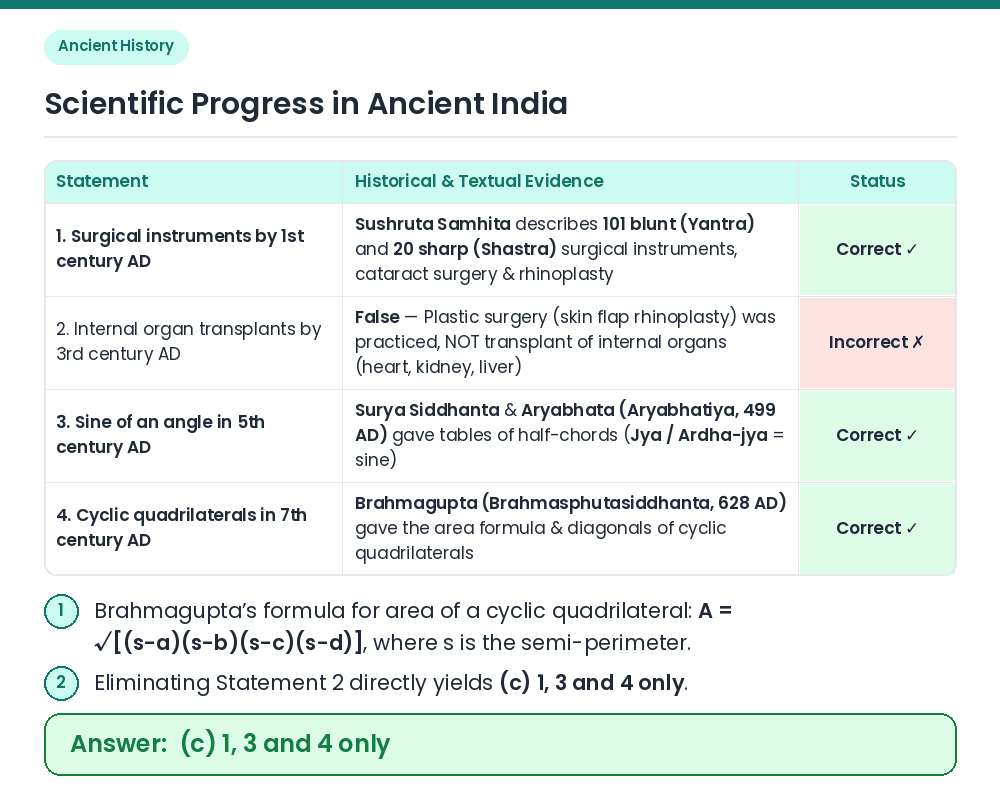
With reference to the scientific progress of ancient India, which of the statements given below are correct? 1. Different kinds of specialized surgical instruments were in common use by 1st century AD. 2. Transplant of internal organs in the human body had begun by the beginning of 3rd century AD. 3. The concept of sine of an angle was known in 5th century AD. 4. The concept of cyclic quadrilaterals was known in 7th century AD. Select the correct answer using the codes given below :
Show answer & explanationShow explanation
Answer: (C) 1, 3 and 4 only
Given / Concept: Ancient India made pioneering contributions to surgery (Ayurveda) and mathematics (trigonometry and geometry). Statement 1 & 2 Analysis: By the 1st century AD, the Sushruta Samhita documented over 120 specialized surgical instruments and external plastic surgery (rhinoplasty) ⇒ Statement 1 is correct. However, transplantation of internal human organs is a 20th-century medical achievement ⇒ Statement 2 is incorrect. Statement 3 Analysis: In the 5th century AD, the Surya Siddhanta and Aryabhata (Aryabhatiya, 499 AD) developed the trigonometric concept of 'Jya' (sine) and 'Koti-jya' (cosine) ⇒ Statement 3 is correct. Statement 4 Analysis: In the 7th century AD, Brahmagupta (Brahmasphutasiddhanta, 628 AD) formulated the exact theorems for the area and diagonals of cyclic quadrilaterals ⇒ Statement 4 is correct. Result: Statements 1, 3 and 4 only are correct. Related Facts: Key milestones of Ancient Indian Science: • Sushruta: Known as the 'Father of Surgery'; detailed 101 blunt instruments (Yantras), 20 sharp instruments (Shastras), lithotomy, and rhinoplasty. • Aryabhata (476–550 AD): Calculated pi (π ≈ 3.1416), explained solar/lunar eclipses scientifically, and proposed Earth's rotation on its axis. • Brahmagupta (598–668 AD): First to give formal rules for arithmetic operations with zero (0) and negative numbers. Correct Answer: (c) 1, 3 and 4 only