Civil Services Examination · Question 35
Which of the following are the methods of Parliamentary control over public finance in India? 1. Placing Annual Financial Statement before the Parliament 2. Withdrawal of moneys from Consolidated Fund of India only after passing the Appropriation Bill 3. Provisions of supplementary grants and vote-on-account 4. A periodic or at least a mid-year review of programme of the Government against macroeconomic forecasts and expenditure by a Parliamentary Budget Office 5. Introducing Finance Bill in the Parliament Select the correct answer using the codes given below :
Show answer & explanationShow explanation
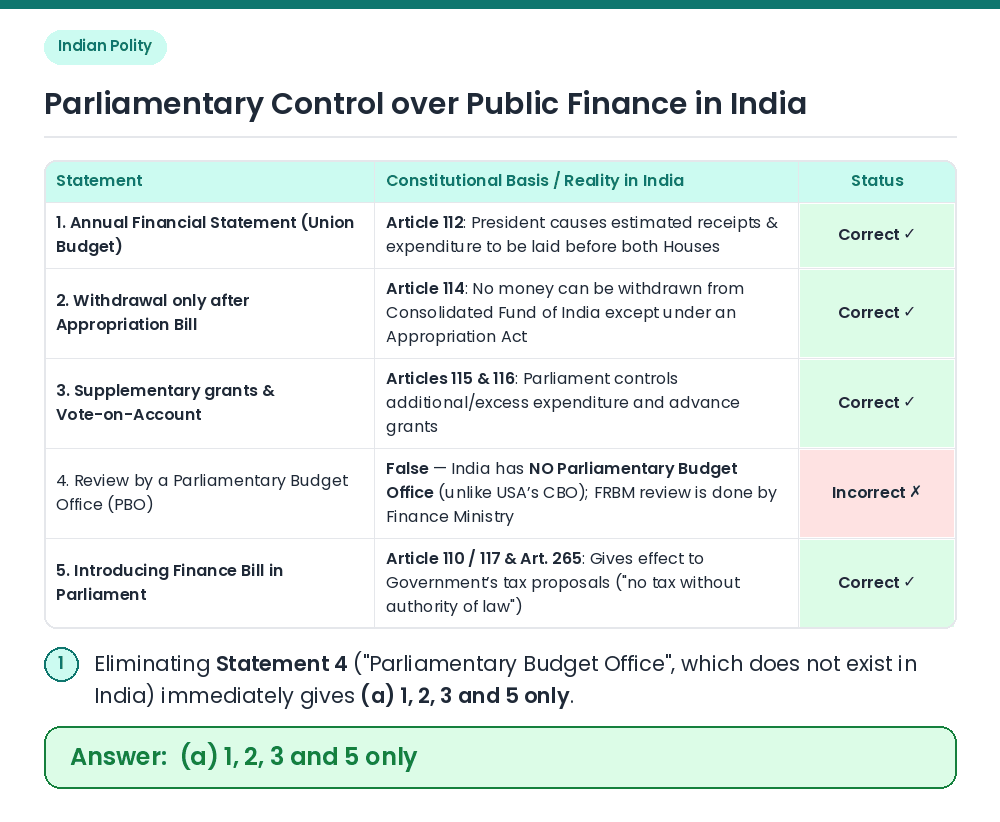
Answer: (A) 1, 2, 3 and 5 only
Given / Concept: The Constitution of India establishes strict parliamentary control over taxation (Article 265) and public expenditure (Articles 112–117 and 266). Statements 1, 2, 3 & 5 Analysis: Placing the Annual Financial Statement before Parliament (Art. 112), passing the Appropriation Bill before withdrawing money from the Consolidated Fund (Art. 114), sanctioning supplementary grants/vote-on-account (Arts. 115–116), and passing the Finance Bill for taxation (Art. 265) are all constitutional instruments of parliamentary financial control ⇒ 1, 2, 3 and 5 are correct. Statement 4 Analysis: Unlike the US Congressional Budget Office (CBO), India does not have a 'Parliamentary Budget Office' (under the FRBM Act, 2003, the mid-year review is placed by the Ministry of Finance itself) ⇒ Statement 4 is incorrect. Result: Statements 1, 2, 3 and 5 only are correct. Related Facts: Two-Stage Parliamentary Control over Public Finance: • Pre-Expenditure Control: Budget discussion, Cut Motions, Voting on Demands for Grants (Lok Sabha only, Art. 113), Appropriation Act (Art. 114), and Finance Act. • Post-Expenditure Audit Control: Exercised through the CAG reports (Art. 151) examined by the three Financial Committees—Public Accounts Committee (PAC), Estimates Committee, and Committee on Public Undertakings (COPU). Correct Answer: (a) 1, 2, 3 and 5 only