Civil Services Examination · Question 37
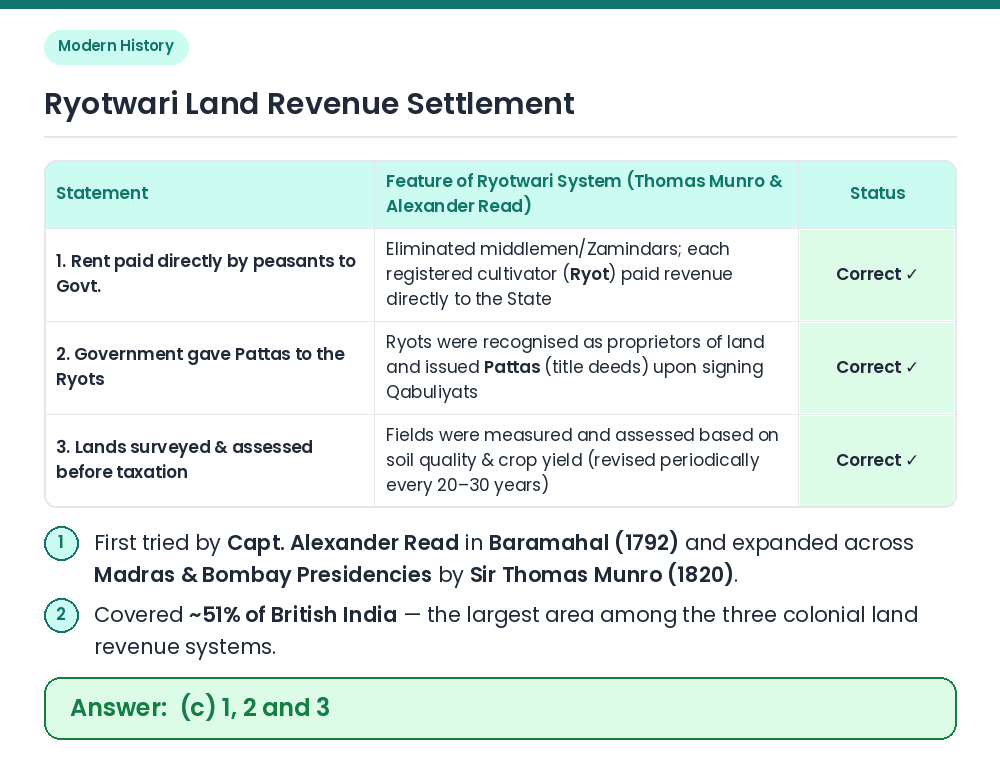
With reference to Ryotwari Settlement, consider the following statements : 1. The rent was paid directly by the peasants to the Government. 2. The Government gave Pattas to the Ryots. 3. The lands were surveyed and assessed before being taxed. Which of the statements given above is/are correct?
Show answer & explanationShow explanation
Answer: (C) 1, 2 and 3
Given / Concept: The Ryotwari Settlement was introduced by Captain Alexander Read (1792) and Sir Thomas Munro (1820) primarily in the Madras and Bombay Presidencies, Assam, and Coorg. Statement 1 & 2 Analysis: Under this system, there were no hereditary intermediaries (Zamindars); the peasant cultivator (Ryot) was recognized as the landowner, given a Patta (ownership deed), and paid land revenue directly to the British Government ⇒ Statements 1 and 2 are correct. Statement 3 Analysis: Before fixing the revenue demand (typically 50% on dry land and 60% on irrigated land), the lands were scientifically surveyed, classified, and assessed according to soil fertility ⇒ Statement 3 is correct. Result: All three statements (1, 2 and 3) are correct. Related Facts: Comparison of the Three British Land Revenue Systems: • Permanent Settlement (1793): Introduced by Lord Cornwallis in Bengal, Bihar, and Orissa (~19% of British India); revenue fixed permanently with Zamindars. • Ryotwari System (1792/1820): Introduced by Read, Munro, and Elphinstone in Madras, Bombay, and Assam (~51% of British India); direct settlement with Ryots. • Mahalwari System (1822): Introduced by Holt Mackenzie and R. M. Bird in North-Western Provinces, Punjab, and Central Provinces (~30% of British India); settlement with the village community (Mahal). Correct Answer: (c) 1, 2 and 3