Civil Services Examination · Question 33
Directions: Read the following passage and answer the item that follows. Your answer to this item should be based on the passage only. Passage Crude mineral oil comes out of the earth as a thick brown or black liquid with a strong smell. It is a complex mixture of many different substances, each with its own individual qualities. Most of them are combinations of hydrogen and carbon in varying proportions. Such hydrocarbons are also found in other forms such as bitumen, asphalt and natural gas. Mineral oil originates from the carcasses of tiny animals and from plants that live in the sea. Over millions of years, these dead creatures form large deposits under the sea-bed; and ocean currents cover them with a blanket of sand and silt. As this mineral hardens, it becomes sedimentary rock and effectively shuts out the oxygen, so preventing the complete decomposition of the marine deposits underneath. The layers of sedimentary rock become thicker and heavier. Their pressure produces heat, which transforms the tiny carcasses into crude oil in a process that is still going on today. Sedimentary rock leads to the formation of oil deposits because
Show answer & explanationShow explanation
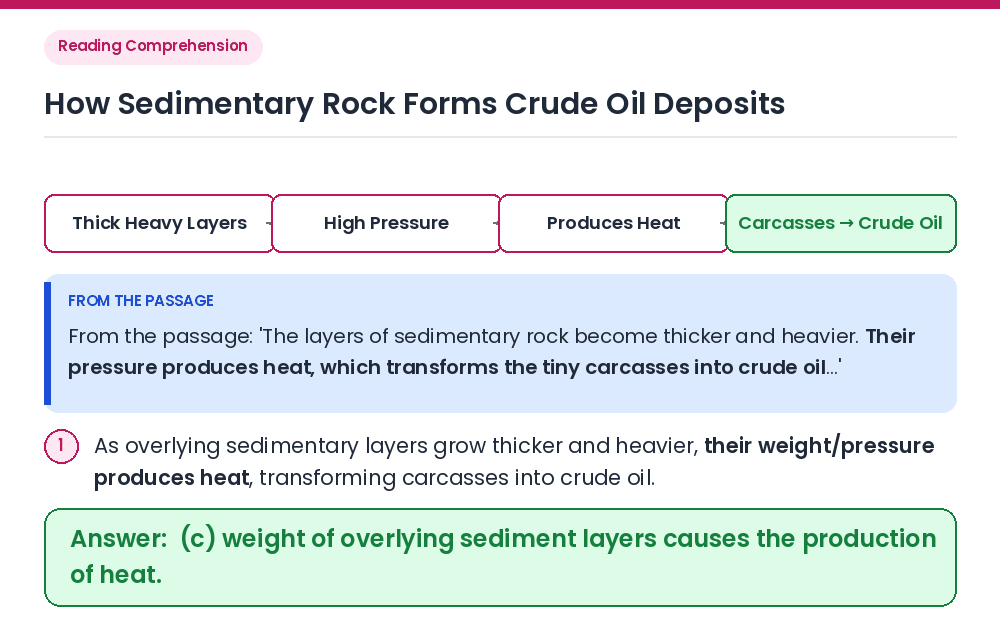
Answer: (C) weight of overlying sediment layers causes the production of heat.
Concept: Check the final two sentences of the passage explaining how sedimentary rock turns carcasses into crude oil. Evidence: The passage states: 'The layers of sedimentary rock become thicker and heavier. Their pressure produces heat, which transforms the tiny carcasses into crude oil.' Result: The weight/pressure of overlying sediment layers causes the production of heat. Correct Answer: (c) weight of overlying sediment layers causes the production of heat.