Civil Services Examination · Question 23
Which one of the following is the correct sequence of ecosystems in the order of decreasing productivity?
Show answer & explanationShow explanation
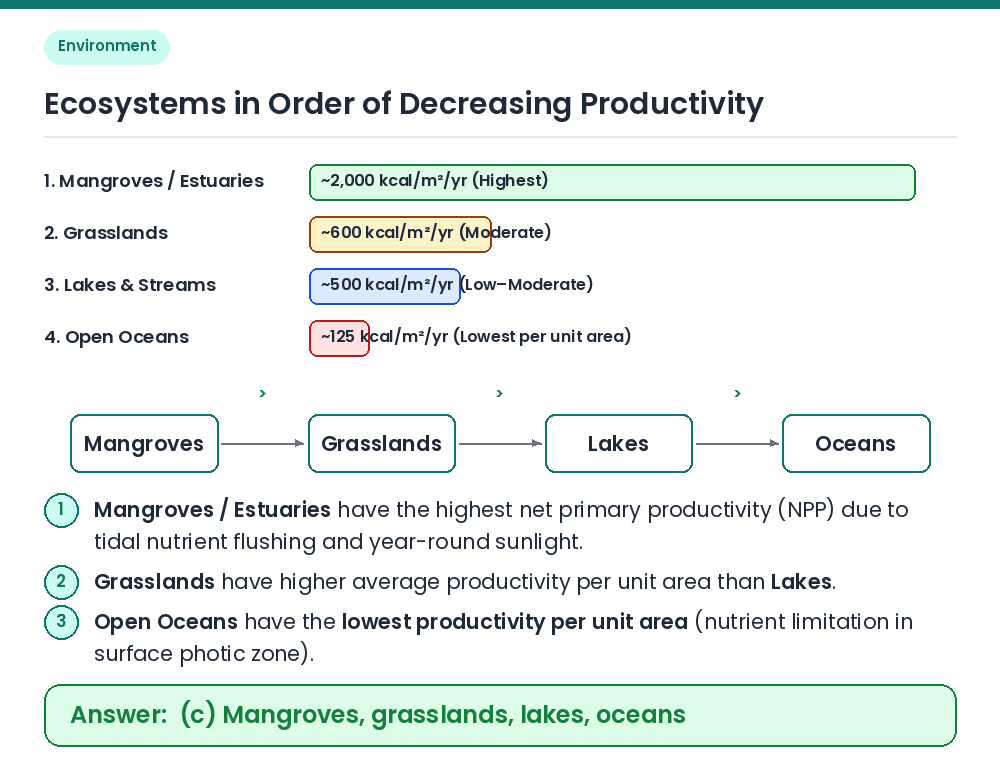
Answer: (C) Mangroves, grasslands, lakes, oceans
Concept: Net Primary Productivity (NPP) per unit area (kcal/m²/year or g/m²/year) of ecosystems as compiled by E.P. Odum. Compare Highest & Lowest: Mangroves, estuaries, swamps and tropical rainforests have the highest productivity (~2,000 kcal/m²/yr) because of abundant sunlight, moisture and tidal nutrient input, whereas open oceans have the lowest productivity per unit area (~125 kcal/m²/yr) due to nutrient scarcity in the sunlit surface zone. Intermediate Ecosystems: Between grasslands (~600 kcal/m²/yr) and lakes (~500 kcal/m²/yr), grasslands have higher average net primary productivity than lakes. Result: The decreasing order of productivity is: Mangroves > Grasslands > Lakes > Oceans. Related Facts: • Per Unit Area vs Total Global Output: Although open oceans have very low productivity per square metre, their vast area (~71% of Earth) gives them a large share of total global biosphere production. • Highest Terrestrial NPP: Tropical rainforests, swamps/marshes and coral reefs rank at the top of primary productivity. Correct Answer: (c) Mangroves, grasslands, lakes, oceans