Civil Services Examination · Question 89
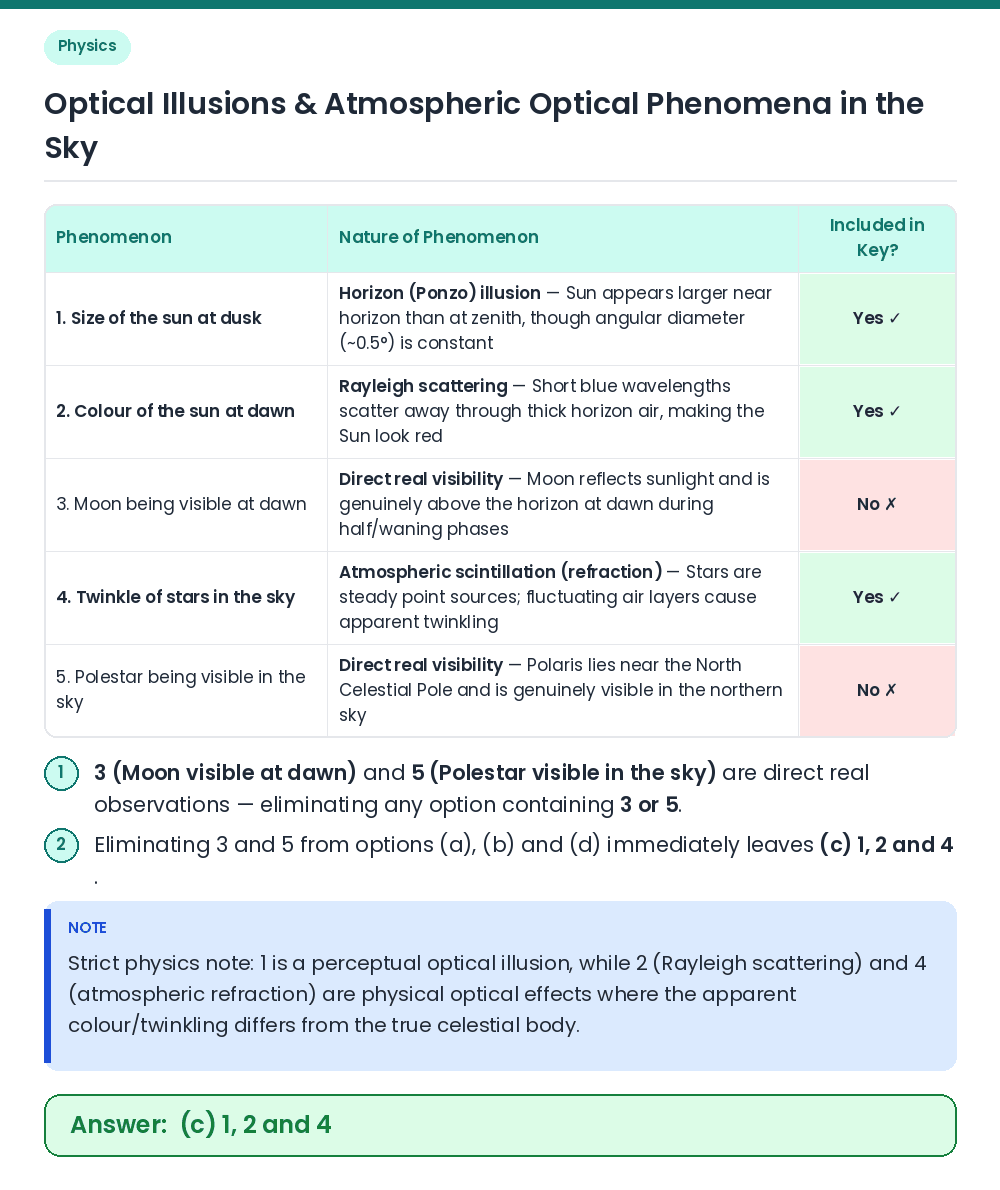
Consider the following phenomena : 1. Size of the sun at dusk 2. Colour of the sun at dawn 3. Moon being visible at dawn 4. Twinkle of stars in the sky 5. Polestar being visible in the sky Which of the above are optical illusions?
Show answer & explanationShow explanation
Answer: (C) 1, 2 and 4
Concept: Distinguish between real direct visibility of celestial bodies (3 and 5) and apparent visual/atmospheric effects where the perceived size, colour or brightness fluctuation differs from the object's intrinsic state (1, 2 and 4). Eliminate 3 & 5: The Moon being visible at dawn (3) and the Polestar (Polaris) being visible in the night sky in the Northern Hemisphere (5) are completely real astronomical observations, not illusions. Eliminating 3 and 5 rules out options (a), (b) and (d). Examine 1, 2 & 4 and Terminology Note: The Sun appearing larger at dusk/horizon than overhead is a classic perceptual optical illusion (Ponzo/horizon illusion — 1). The reddish colour of the Sun at dawn (due to Rayleigh scattering of shorter wavelengths — 2) and the twinkling of stars (due to atmospheric refraction across turbulent air layers — 4) are physical atmospheric optical phenomena that UPSC grouped under 'optical illusions' in contrast to 3 and 5. Result: Phenomena 1, 2 and 4 are the correct choice. Related Facts: • Apparent Early Sunrise & Late Sunset: Atmospheric refraction makes the Sun visible ~2 minutes before actual sunrise and ~2 minutes after actual sunset. • Why Planets Do Not Twinkle: Planets are much closer to Earth and appear as extended discs (collection of many point sources whose refraction fluctuations average out). Correct Answer: (c) 1, 2 and 4