Civil Services Examination · Question 91
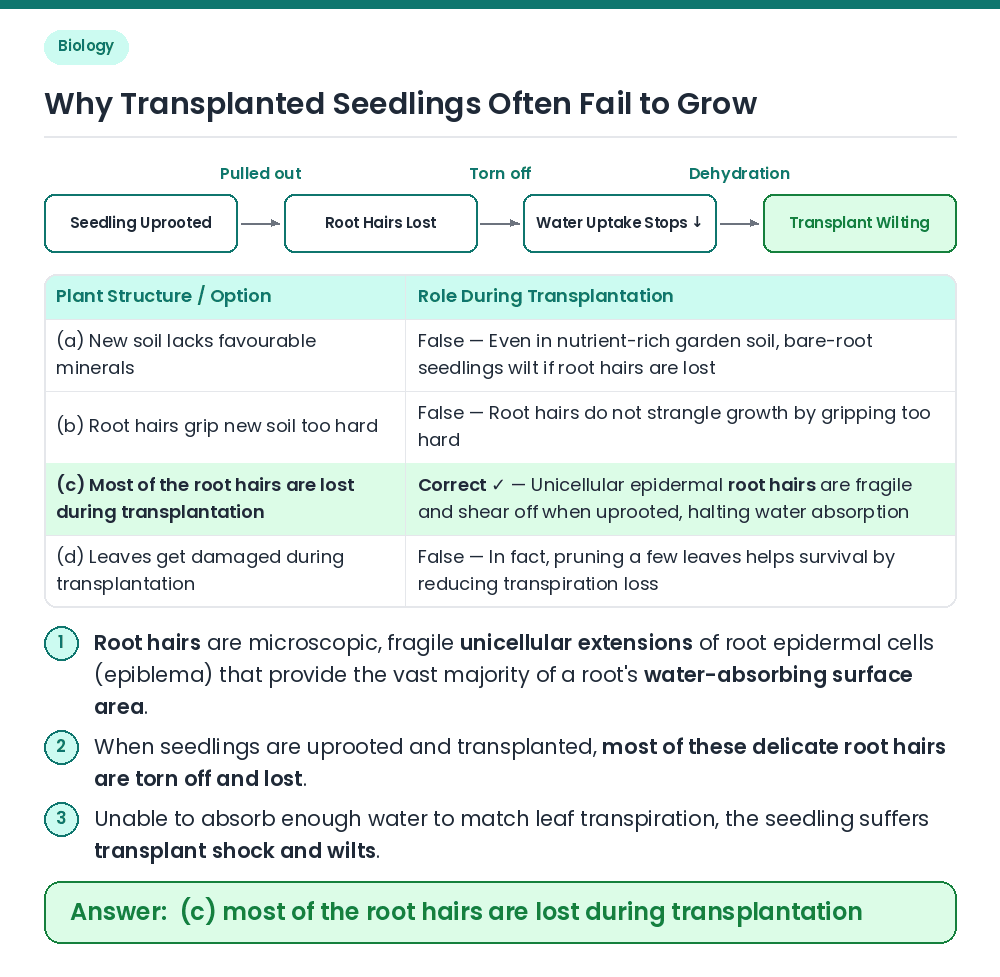
Many transplanted seedlings do not grow because
Show answer & explanationShow explanation
Answer: (C) most of the root hairs are lost during transplantation
Concept: Water and mineral absorption in young plants takes place primarily in the zone of maturation through microscopic unicellular root hairs. Damage During Uprooting: Root hairs are delicate, thin-walled tubular outgrowths of the root epidermis (epiblema) that are intimately enmeshed with soil particles. When a seedling is pulled out of its nursery bed and transplanted, most of these fragile root hairs are mechanically sheared off and lost. Physiological Consequence: With the loss of root hairs, the absorptive surface area of the root drops drastically, so water uptake cannot keep pace with water loss through leaf transpiration, causing the seedling to wilt and fail to grow ('transplant shock'). Result: Many transplanted seedlings do not grow because most of the root hairs are lost during transplantation. Related Facts: • Practical Remedy: Seedlings are transplanted with an intact ball of soil around their roots (or in the evening/cloudy weather) to protect root hairs and minimize transpiration. • Zone of Root Hairs: Located just behind the zone of elongation near the root tip; root hairs are short-lived and lack a cuticle. Correct Answer: (c) most of the root hairs are lost during transplantation