Civil Services Examination · Question 94
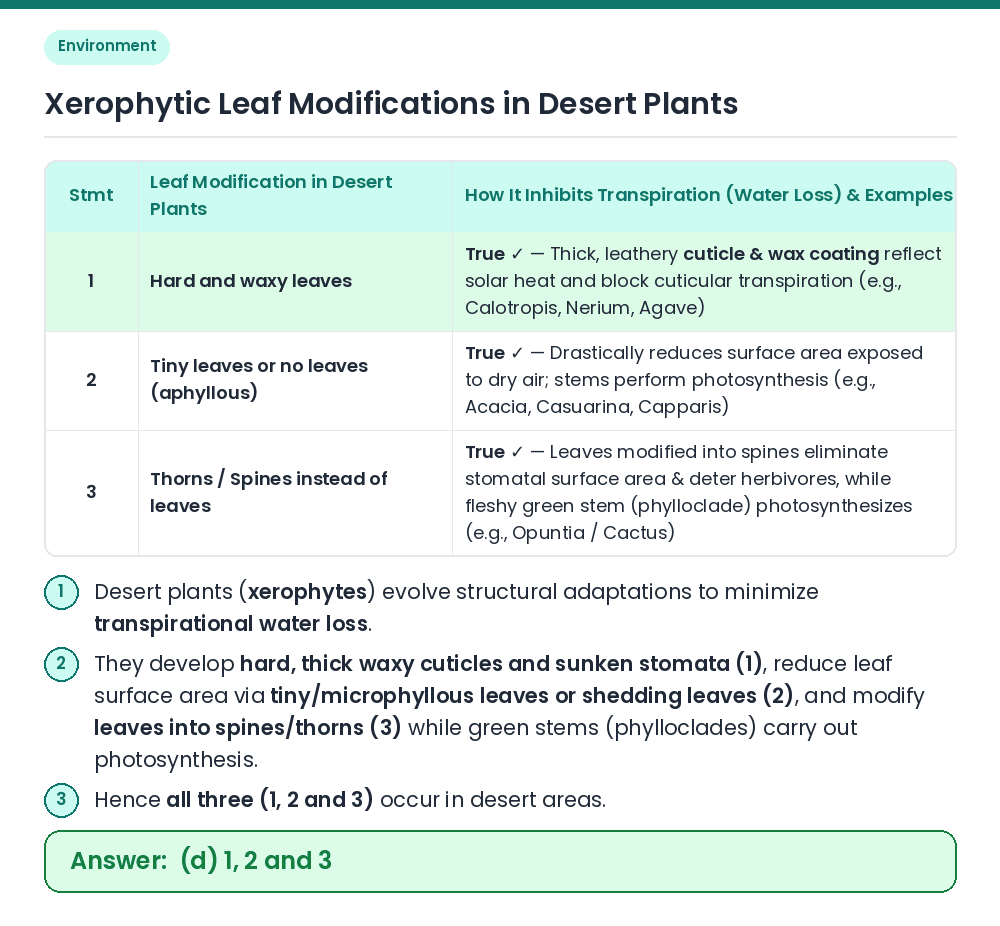
Which of the following leaf modifications occurs/occur in desert areas to inhibit water loss? 1. Hard and waxy leaves 2. Tiny leaves or no leaves 3. Thorns instead of leaves Select the correct answer using the codes given below.
Show answer & explanationShow explanation
Answer: (D) 1, 2 and 3
Concept: Xerophytes (desert plants) face acute water scarcity and intense heat, and evolve morphological leaf adaptations to minimize water loss through transpiration. Check Modifications 1, 2 & 3: (1) Many desert shrubs have hard, leathery leaves coated with a thick waxy cuticle and sunken stomata to create a waterproof barrier (1 is correct). (2) Others bear tiny (microphyllous) leaves (e.g., Acacia, Prosopis) or shed leaves completely during dry seasons (aphyllous, e.g., Capparis decidua) to minimize transpiring surface area (2 is correct). (3) Succulents like Opuntia (prickly pear cactus) and Euphorbia modify their leaves into spines/thorns while their flattened green stem (phylloclade) performs photosynthesis (3 is correct). Result: All three leaf modifications — 1, 2 and 3 — occur in desert areas to inhibit water loss. Related Facts: • CAM Photosynthesis (Crassulacean Acid Metabolism): Desert plants like cacti keep their stomata closed during the hot day and open them only at night to fix CO₂, drastically cutting water loss. • Sunken Stomata: Stomata located in deep pits lined with epidermal hairs (trichomes) trap moist air and reduce wind-driven transpiration. Correct Answer: (d) 1, 2 and 3