Civil Services Examination · Question 99
The national income of a country for a given period is equal to the
Show answer & explanationShow explanation
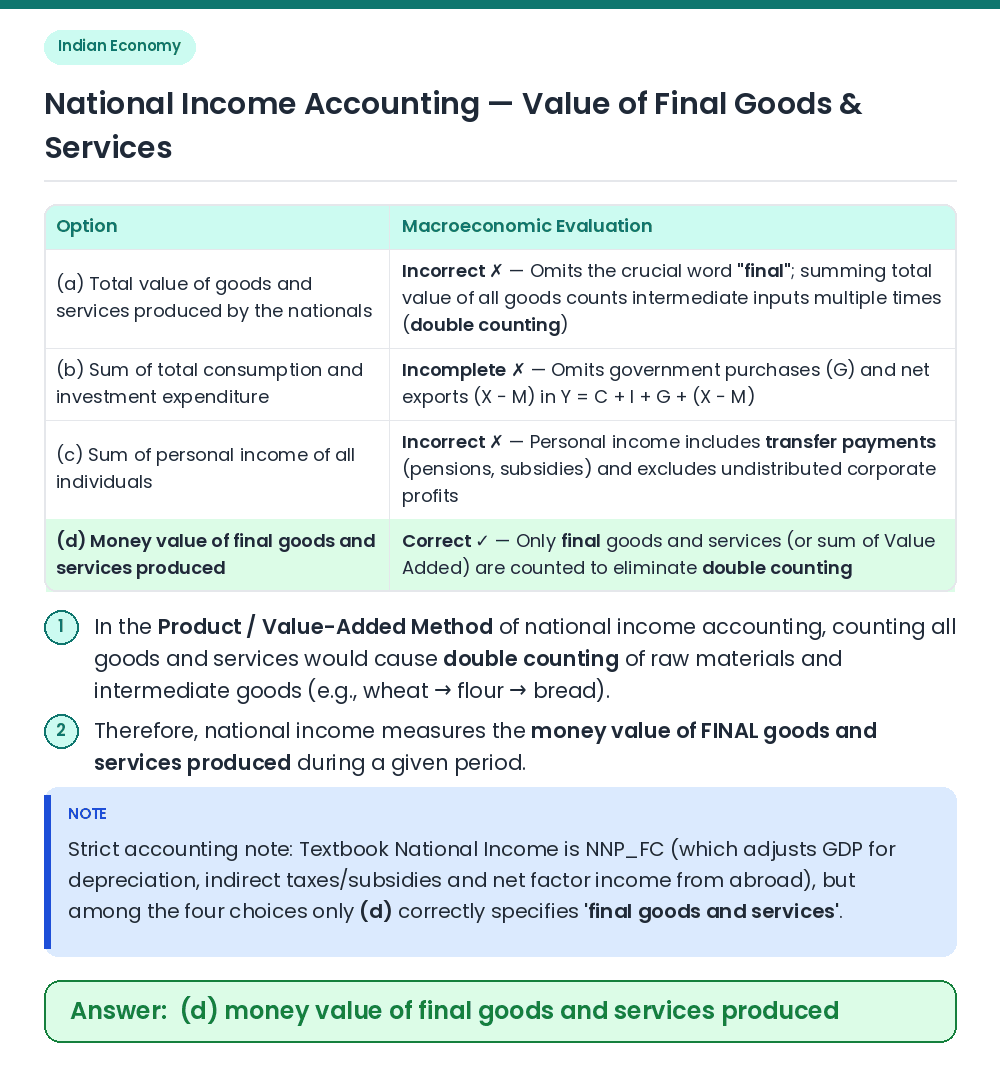
Answer: (D) money value of final goods and services produced
Concept: In macroeconomic national income accounting (Product Method), national output/income is measured by valuing only final goods and services to avoid the error of double counting. Step 2 (Compare Option (a) vs Option (d)): Option (a) states 'total value of goods and services', which includes intermediate goods (such as cotton used to make yarn, and yarn used to make cloth) and leads to multiple counting of the same output. Option (d) specifies the 'money value of final goods and services produced', which accurately reflects net value added. Step 3 (Eliminate Options (b) & (c)): Option (b) omits government final expenditure and net exports; Option (c) (Personal Income) includes non-productive transfer payments (pensions, scholarships) and excludes corporate retained earnings and corporate taxes. Result & Nuance Note: While strict National Income is NNP at Factor Cost (adjusting for depreciation, net indirect taxes and net factor income from abroad), among the given options (d) is the official UPSC answer because 'final goods and services' is the defining condition of national product estimation. Related Facts: • Three Methods of National Income Estimation: Product (Value Added) Method, Income (Factor Payment) Method, and Expenditure Method (C + I + G + X − M). • CSO / NSO: In India, National Income estimates are compiled and published by the National Statistical Office (NSO, under MoSPI). Correct Answer: (d) money value of final goods and services produced