Civil Services Examination · Question 78
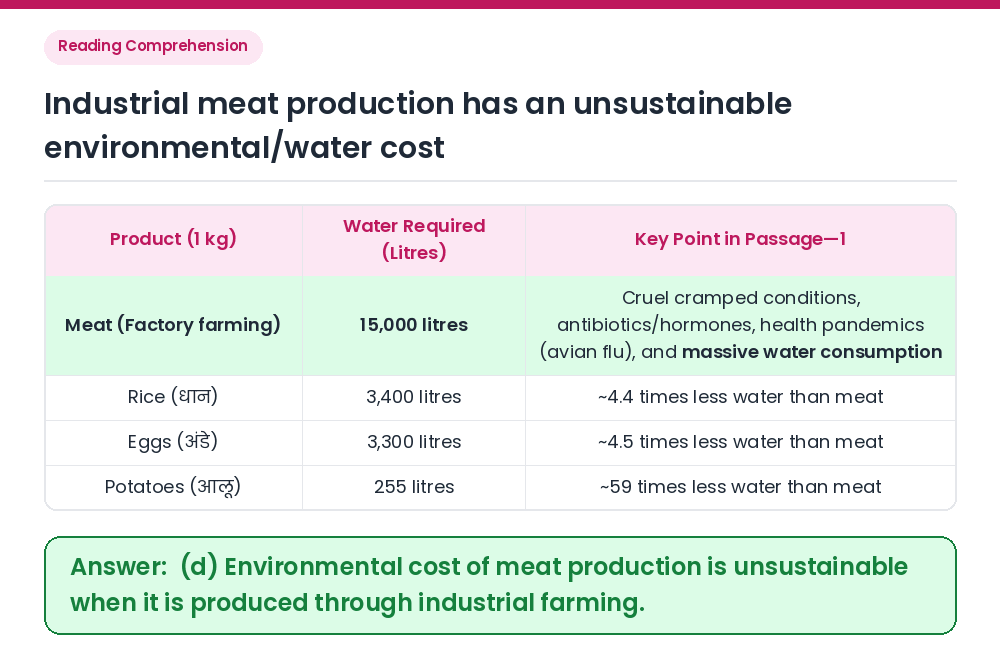
Directions for the following 3 (three) items : Read the following two passages and answer the items that follow. Your answers to these items should be based on the passages only. Passage—1 The quest for cheap and plentiful meat has resulted in factory farms where more and more animals are squeezed into smaller lots in cruel and shocking conditions. Such practices have resulted in many of the world's health pandemics such as the avian flu. Worldwide, livestock are increasingly raised in cruel, cramped conditions, where animals spend their short lives under artificial light, pumped full of antibiotics and growth hormones, until the day they are slaughtered. Meat production is water-intensive. 15000 litres of water is needed for every kilogram of meat compared with 3400 litres for rice, 3300 litres for eggs and 255 litres for a kilogram of potatoes. What is the most rational and crucial message given by the passage?
Show answer & explanationShow explanation
Answer: (D) Environmental cost of meat production is unsustainable when it is produced through industrial farming.
Given: Passage—1 highlights the negative impacts of factory farming (cruel conditions, pandemics, antibiotics/hormones, and extreme water consumption of 15,000 L/kg). Eliminate Options a and b: (a) promotes industrial meat production, contrary to the passage; (b) mentions 'laws against cruelty', whereas laws are never mentioned in the text. Compare Options c and d: Option (c) calls for an extreme immediate ban ('stopped immediately'), whereas Option (d) synthesizes the health/ecological toll and massive water footprint (15,000 L/kg vs 255 L/kg for potatoes) into the rational message that its environmental cost is unsustainable. Correct Answer: (d) Environmental cost of meat production is unsustainable when it is produced through industrial farming.