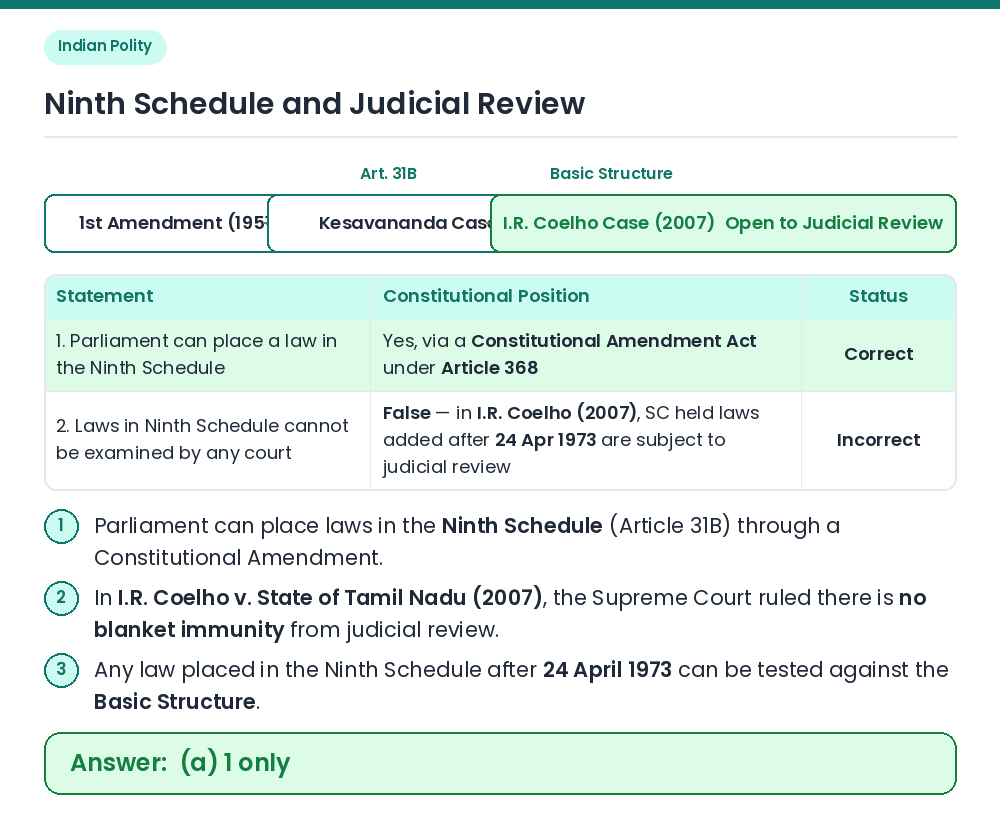
Civil Services Examination · Question 5
Consider the following statements : 1. The Parliament of India can place a particular law in the Ninth Schedule of the Constitution of India. 2. The validity of a law placed in the Ninth Schedule cannot be examined by any court and no judgement can be made on it. Which of the statements given above is/are correct ?
Show answer & explanationShow explanation
Answer: (A) 1 only
Concept: Scope of Article 31B and judicial review of laws placed in the Ninth Schedule of the Constitution. Statement 1: The Parliament of India can place a central or state law into the Ninth Schedule through a Constitutional Amendment under Article 368 ⇒ Statement 1 is correct. Statement 2: In I.R. Coelho v. State of Tamil Nadu (2007), a 9-judge bench of the Supreme Court ruled that laws placed in the Ninth Schedule after 24 April 1973 are open to judicial review if they violate Fundamental Rights (Articles 14, 19, 21) or the Basic Structure ⇒ Statement 2 is incorrect. Result: Only statement 1 is correct, making option (a) the right choice. Related Facts: • Origin: The Ninth Schedule and Article 31B were added by the 1st Constitutional Amendment Act, 1951 (during PM Jawaharlal Nehru's tenure) to protect agrarian land reform laws. • Cut-off Date: 24 April 1973 is the date of the landmark Kesavananda Bharati judgment that propounded the Basic Structure doctrine. • Judicial Review: The Supreme Court held that judicial review itself is an essential feature of the Basic Structure and cannot be excluded by the Ninth Schedule. Correct Answer: (a) 1 only