Civil Services Examination · Question 8
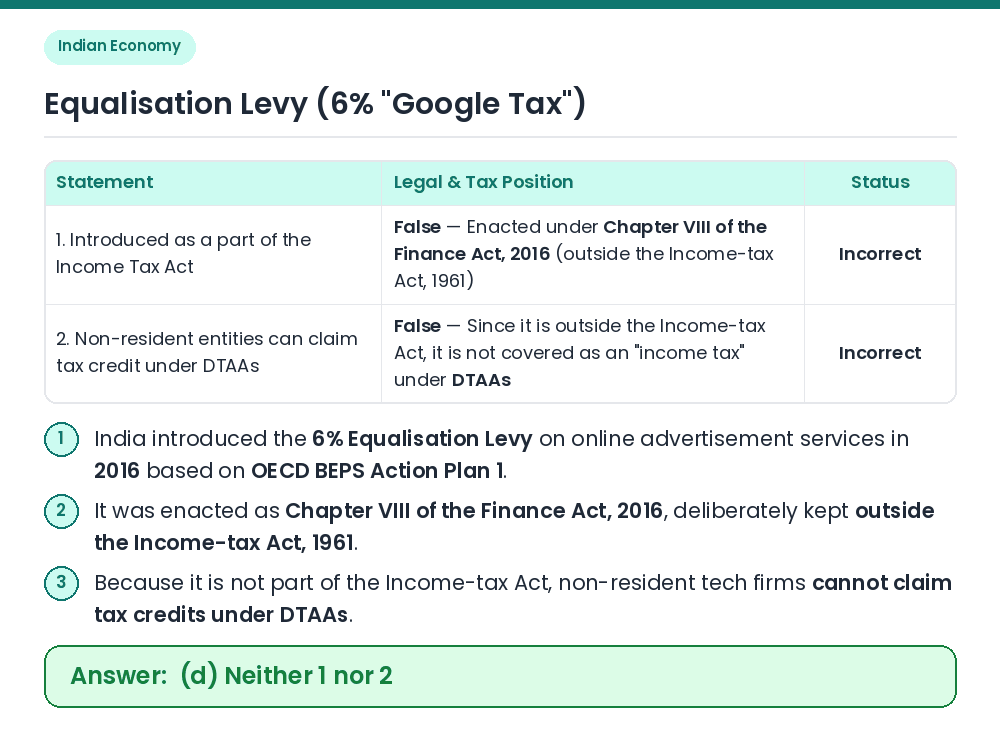
With reference to India's decision to levy an equalization tax of 6% on online advertisement services offered by non-resident entities, which of the following statements is/are correct ? 1. It is introduced as a part of the Income Tax Act. 2. Non-resident entities that offer advertisement services in India can claim a tax credit in their home country under the "Double Taxation Avoidance Agreements". Select the correct answer using the code given below :
Show answer & explanationShow explanation
Answer: (D) Neither 1 nor 2
Concept: Legal framework of India's 6% Equalisation Levy ('Google Tax') on B2B online advertisement services by non-residents. Statement 1: The 6% Equalisation Levy was introduced as a separate, standalone provision under Chapter VIII of the Finance Act, 2016, and NOT as part of the Income-tax Act, 1961 ⇒ Statement 1 is incorrect. Statement 2: Double Taxation Avoidance Agreements (DTAAs) apply only to taxes on income covered under the Income-tax Act; since the Equalisation Levy falls outside the Income-tax Act, non-resident entities cannot automatically claim foreign tax credit under DTAAs ⇒ Statement 2 is incorrect. Result: Neither statement 1 nor statement 2 is correct, so option (d) is the right answer. Related Facts: • OECD BEPS Origin: Introduced following the OECD Base Erosion and Profit Shifting (BEPS) Action Plan 1 report on taxing the digital economy. • Threshold: Applicable on B2B payments exceeding ₹1 lakh in a financial year to a non-resident service provider without a permanent establishment in India. • Akhilesh Ranjan Committee: The Committee on Taxation of E-Commerce (2016) recommended introducing the Equalisation Levy in India. Correct Answer: (d) Neither 1 nor 2