Civil Services Examination · Question 7
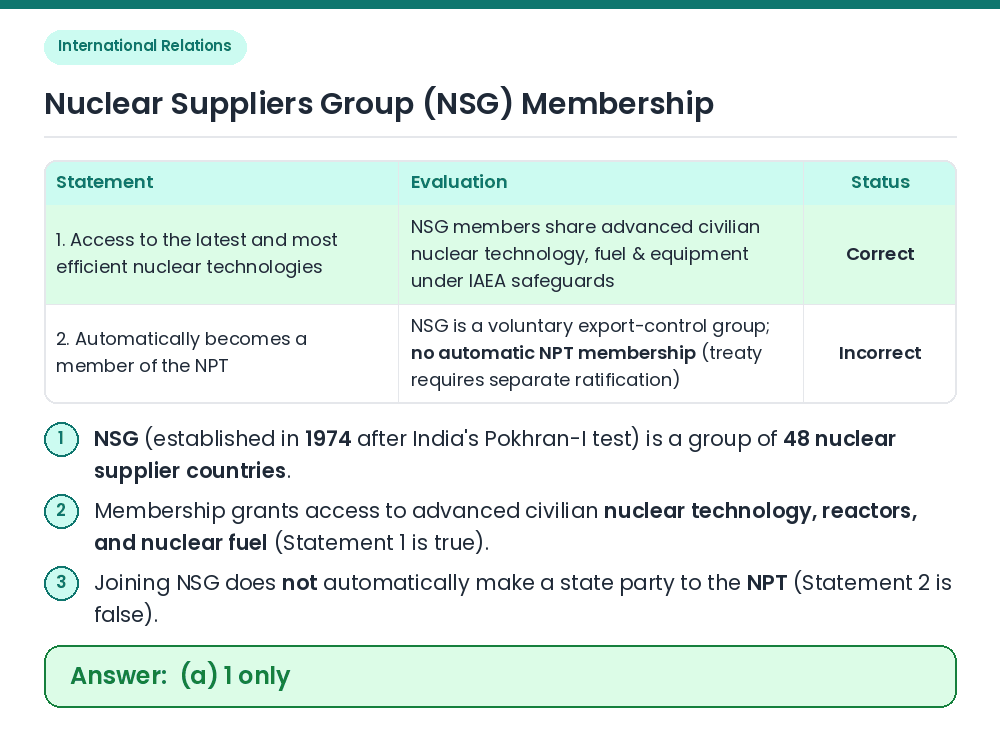
What is/are the consequence/consequences of a country becoming the member of the 'Nuclear Suppliers Group' ? 1. It will have access to the latest and most efficient nuclear technologies. 2. It automatically becomes a member of "The Treaty on the Non-Proliferation of Nuclear Weapons (NPT)". Which of the statements given above is/are correct ?
Show answer & explanationShow explanation
Answer: (A) 1 only
Concept: Nature, rules, and benefits of the Nuclear Suppliers Group (NSG) vis-à-vis the Nuclear Non-Proliferation Treaty (NPT). Statement 1: Becoming an NSG member enables unrestricted trade in civilian nuclear materials, reactors, and the latest nuclear technologies among member nations ⇒ Statement 1 is correct. Statement 2: The NPT (1968) is an international treaty, while the NSG (1974) is a voluntary multilateral export-control arrangement; joining NSG does not automatically make a state a party to the NPT (e.g., France joined NSG at inception in 1974–75 but acceded to the NPT only in 1992) ⇒ Statement 2 is incorrect. Result: Only statement 1 is correct, so option (a) is the right answer. Related Facts: • Origin of NSG: Formed in 1974 (also called the 'London Club') in response to India's first nuclear test ('Smiling Buddha') in May 1974; currently has 48 members. • 2008 India Waiver: In September 2008, the NSG granted India a clean waiver allowing civilian nuclear trade despite India not being an NPT signatory. • Four Export Control Regimes: NSG (nuclear), MTCR (missiles), Australia Group (chemical/biological), and Wassenaar Arrangement (conventional/dual-use) — India is a member of all except NSG. Correct Answer: (a) 1 only