Civil Services Examination · Question 27
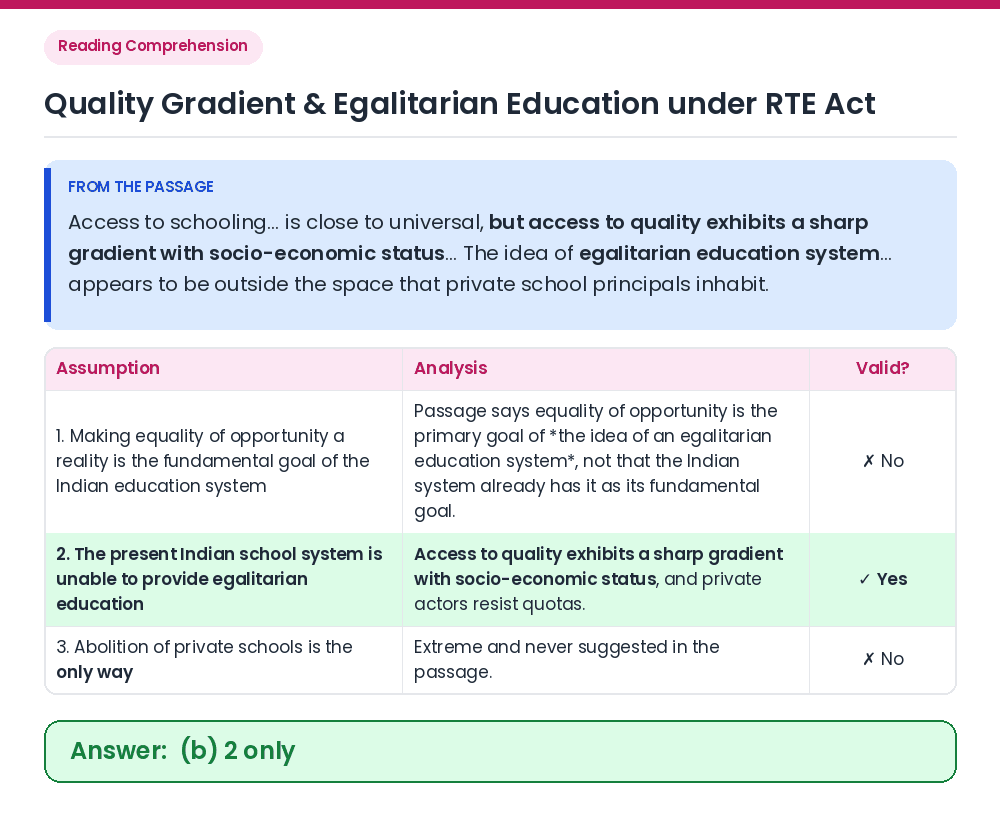
Passage – 5 Access to schooling for those coming of school age is close to universal, but access to quality exhibits a sharp gradient with socio-economic status. Quotas for the weaker sections in private schools is a provision introduced by the Right of Children to Free and Compulsory Education Act, 2009. The quotas have imposed a debate on issues of social integration and equity in education that private actors had escaped by and large. The idea of egalitarian education system with equality of opportunity as its primary goal appears to be outside the space that private school principals inhabit. Therefore, the imposition of the quotas has led to resistance, sometimes justified. With reference to the above passage, the following assumptions have been made : 1. Making equality of opportunity a reality is the fundamental goal of the Indian education system. 2. The present Indian school system is unable to provide egalitarian education. 3. Abolition of private schools and establishment of more government schools is the only way to ensure egalitarian education. Which of the above assumptions is/are valid?
Show answer & explanationShow explanation
Answer: (B) 2 only
Check Assumption 1: The passage defines 'an egalitarian education system' as one 'with equality of opportunity as its primary goal', not stating that this is already the fundamental goal of the Indian education system. Check Assumption 2: The passage explicitly states that 'access to quality exhibits a sharp gradient with socio-economic status' and private actors resist equity quotas. This implies the present school system is unable to provide egalitarian education. (Valid) Check Assumption 3: Calling for the 'abolition of private schools' as 'the only way' is an extreme measure not supported by the passage. (Invalid) Result: Only assumption 2 is valid. Correct Answer: (b) 2 only