Civil Services Examination · Question 46
Passage – 5 A vast majority of Indians are poor, with barely 10 percent employed in the organised sector. We are being convinced that vigorous economic growth is generating substantial employment. But this is not so. When our economy was growing at 3 percent per year, employment in the organised sector was growing at 2 percent per year. As the economy began to grow at 7 – 8 percent per year, the rate of growth of employment in the organised sector actually declined to 1 percent per year. The above passage seems to imply that 1. most of modern economic growth is based on technological progress. 2. much of modern Indian economy does not nurture sufficient symbiotic relationship with labour-intensive, natural resource-based livelihoods. 3. service sector in India is not very labour-intensive. 4. literate rural population is not willing to enter organised sector. Which of the statements given above are correct?
Show answer & explanationShow explanation
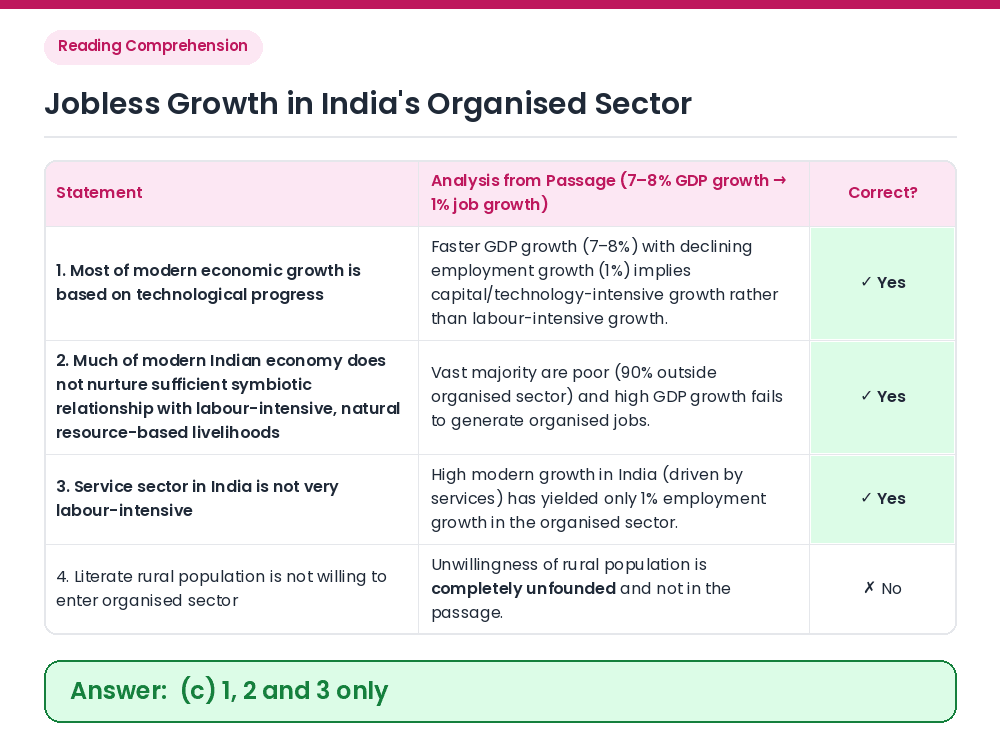
Answer: (C) 1, 2 and 3 only
Analyze Passage: The passage contrasts high economic growth (7–8% per year) with falling employment growth in the organised sector (down from 2% to 1% per year), while a vast majority remain poor outside the organised sector. Eliminate Statement 4: ⇒ Statement 4 claims that the 'literate rural population is not willing to enter organised sector', which is patently false and unsupported by the text (eliminating options b and d). Compare 1, 2, and 3: ⇒ Why does 7–8% GDP growth generate only 1% employment growth? Because modern growth relies on technology/automation (1), disconnects from labour-intensive livelihoods of the poor majority (2), and India's growth-driving service sector is not very labour-intensive (3). Result: Statements 1, 2 and 3 are correct. Correct Answer: (c) 1, 2 and 3 only