Civil Services Examination · Question 50
If the numerator and denominator of a proper fraction are increased by the same positive quantity which is greater than zero, the resulting fraction is
Show answer & explanationShow explanation
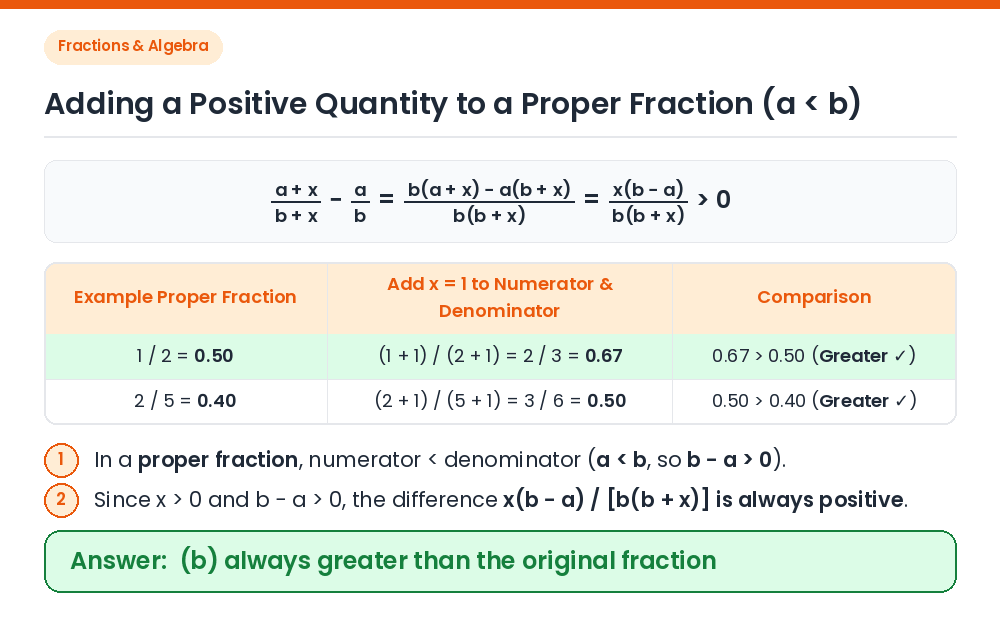
Answer: (B) always greater than the original fraction
Concept: In a proper fraction a/b (where a, b > 0), the numerator is strictly less than the denominator (a < b, so b − a > 0). Algebraic Proof: ⇒ Increase both numerator and denominator by x > 0 to get (a + x)/(b + x). ⇒ Difference = (a + x)/(b + x) − a/b = [ab + bx − ab − ax] / [b(b + x)] = x(b − a) / [b(b + x)]. ⇒ Since x > 0, b > 0, and (b − a) > 0, the difference is strictly positive (> 0). Result: The resulting fraction is always greater than the original fraction. Shortcut: Take a/b = 1/2 (0.5) and x = 1 ⇒ (1+1)/(2+1) = 2/3 (0.67) > 1/2. Correct Answer: (b) always greater than the original fraction