Civil Services Examination · Question 61
Directions for the following 7 (seven) items : Read the following five passages and answer the items that follow each passage. Your answers to these items should be based on the passages only. Passage – 1 India's economic footprint, given its population, still remains small compared to the US, the European Union or China. It has much to learn from other economies, yet must implement solutions that fit its unique circumstances. India especially needs an effective long-term regulatory system based on collaboration rather than the current top-down approach. Regulations seek desirable outcomes yet are repeatedly used as political tools to push one agenda or another. Often, regulations fail to consider impacts on jobs and economic growth — or less restrictive alternatives. Regulations may be used to protect local markets at the expense of more widely shared prosperity in the future. Additionally, regulations inevitably result in numerous unintended consequences. In today's hyper competitive global economy, regulations need to be viewed as "weapons" that seek cost-justified social and environmental benefits while improving the economic well-being of most citizens. Which one of the following is the most logical, rational and crucial inference that can be derived from the above passage?
Show answer & explanationShow explanation
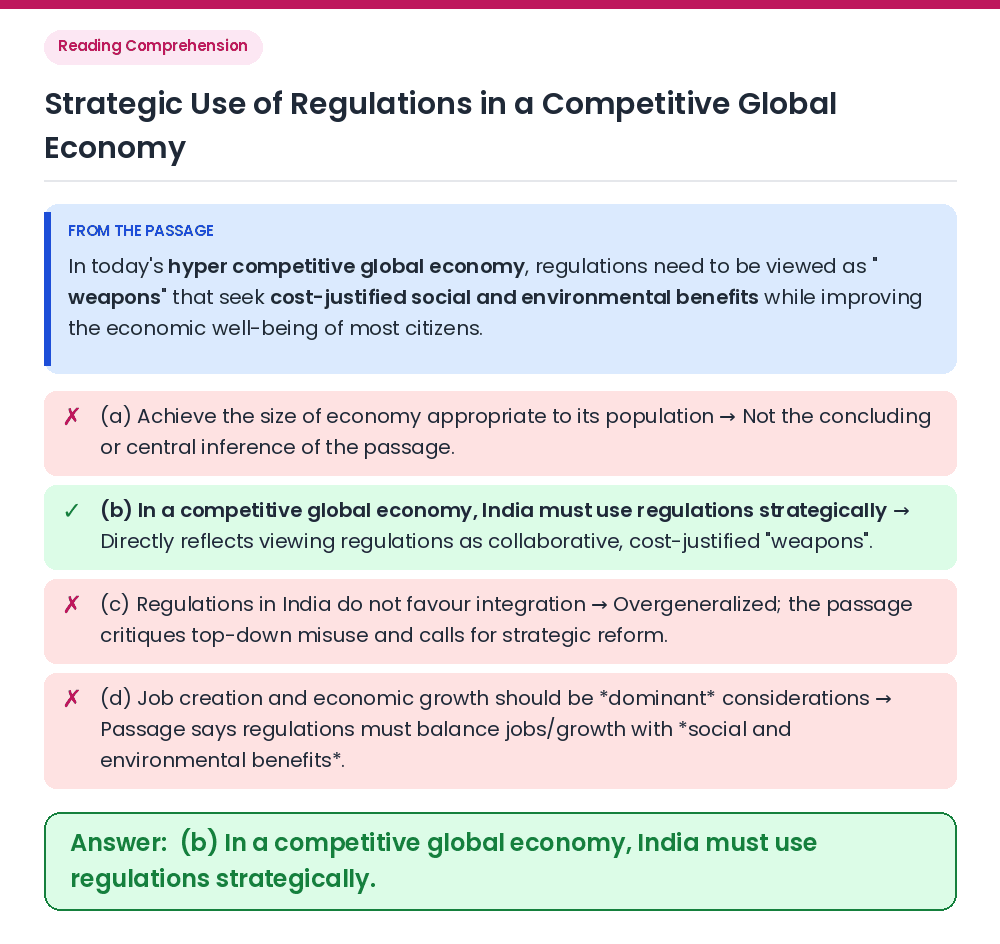
Answer: (B) In a competitive global economy, India must use regulations strategically.
Analyze Passage: The passage argues that India needs a collaborative, long-term regulatory system where regulations are not used as short-sighted political tools, but viewed as 'weapons' in today's hyper-competitive global economy to achieve cost-justified social, environmental, and economic benefits. Evaluate Options: ⇒ (a) & (c) Incorrect: Neither matching population size nor opposing global integration is the core message. ⇒ (d) Incomplete: Making jobs and growth the 'dominant' considerations ignores the equal emphasis placed on 'cost-justified social and environmental benefits'. Result: The crucial inference is that India must use regulations strategically in a competitive global economy. Correct Answer: (b) In a competitive global economy, India must use regulations strategically.