Civil Services Examination · Question 43
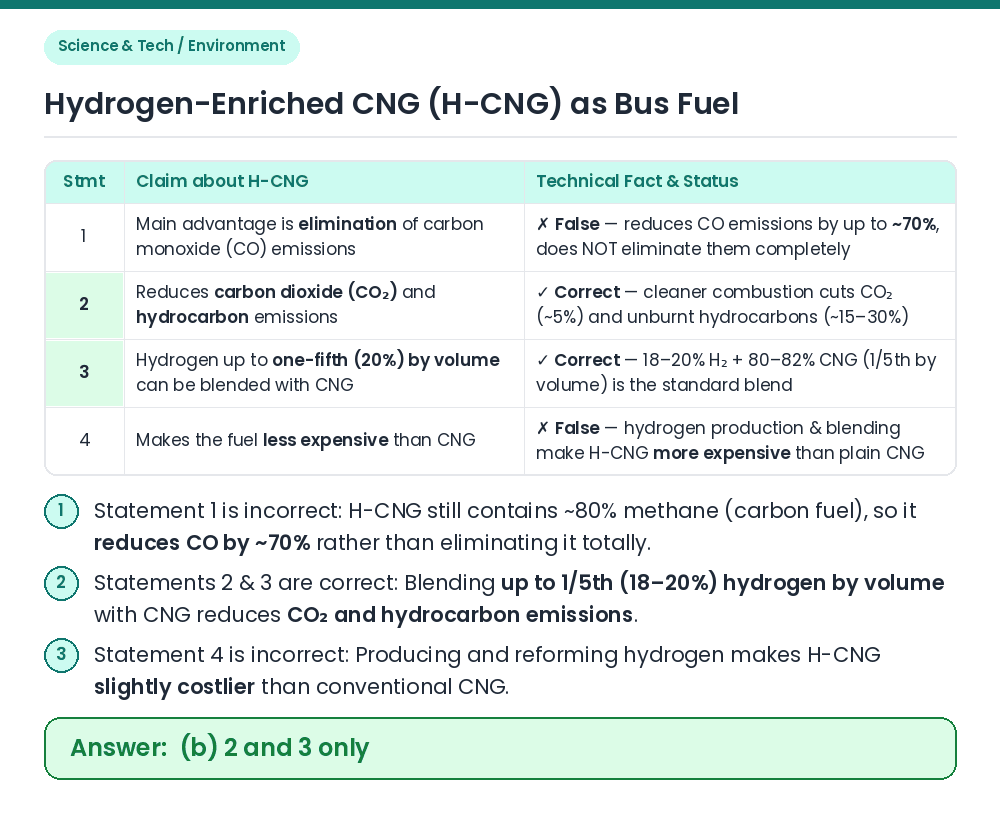
In the context of proposals to the use of hydrogen-enriched CNG (H-CNG) as fuel for buses in public transport, consider the following statements : 1. The main advantage of the use of H-CNG is the elimination of carbon monoxide emissions. 2. H-CNG as fuel reduces carbon dioxide and hydrocarbon emissions. 3. Hydrogen up to one-fifth by volume can be blended with CNG as fuel for buses. 4. H-CNG makes the fuel less expensive than CNG. Which of the statements given above is/are correct?
Show answer & explanationShow explanation
Answer: (B) 2 and 3 only
Given / Concept: H-CNG (Hythane) is a blend of hydrogen and compressed natural gas (methane) used in internal combustion engines without major engine redesign. Statements 1 & 4: Since ~80% of H-CNG is still methane (CH4), burning it reduces Carbon Monoxide (CO) emissions by ~70% but does NOT eliminate CO completely (Statement 1 ✗) ⇒ Due to the cost of producing hydrogen (e.g., compact methane reforming), H-CNG is slightly more expensive than regular CNG (Statement 4 ✗). Statements 2 & 3: H-CNG improves fuel economy by 3–4% and reduces CO2 and hydrocarbon emissions (Statement 2 ✓) ⇒ Blending 18–20% (one-fifth) hydrogen by volume with CNG is the standard approved ratio for buses (Statement 3 ✓). Result: Only Statements 2 and 3 are correct. Related Facts: • Compact Reforming Process: Indian Oil Corporation (IOCL) developed a compact reforming process to produce 18% H-CNG directly from natural gas for Delhi buses. • Regulatory Approval: In 2020, MoRTH notified 18% H-CNG blend as an automotive fuel under BIS standard IS 17314:2019. Correct Answer: (b) 2 and 3 only