Civil Services Examination · Question 46
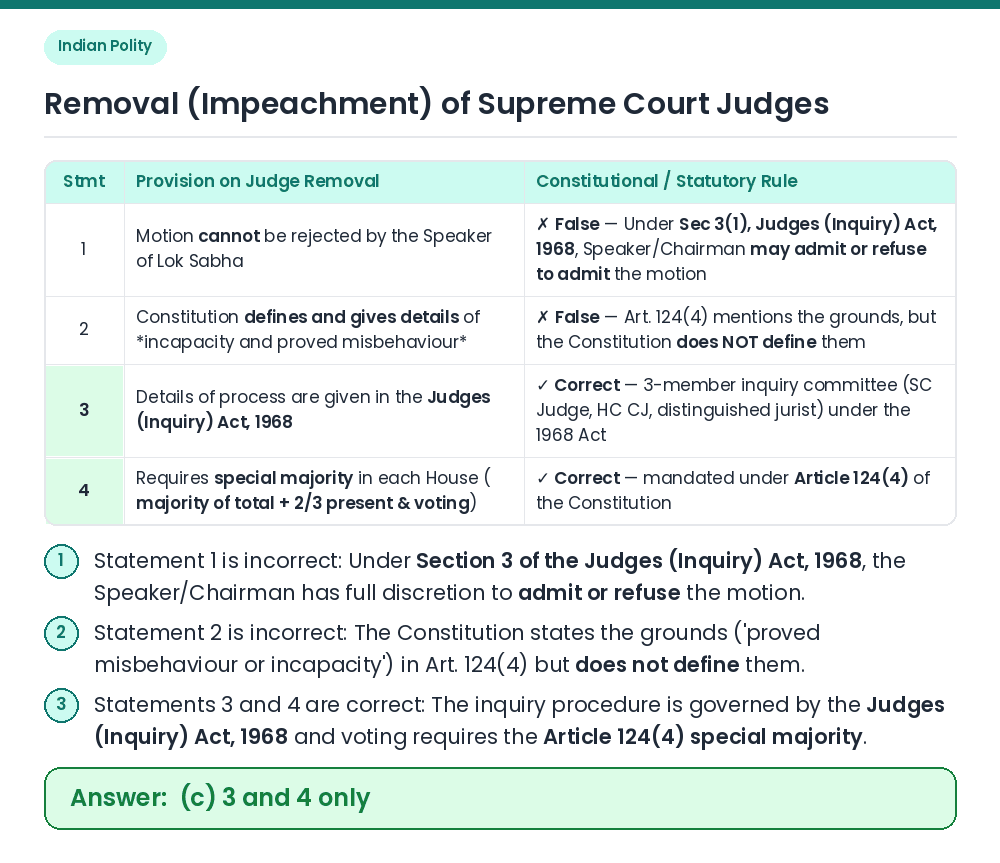
Consider the following statements : 1. The motion to impeach a Judge of the Supreme Court of India cannot be rejected by the Speaker of the Lok Sabha as per the Judges (Inquiry) Act, 1968. 2. The Constitution of India defines and gives details of what constitutes 'incapacity and proved misbehaviour' of the Judges of the Supreme Court of India. 3. The details of the process of impeachment of the Judges of the Supreme Court of India are given in the Judges (Inquiry) Act, 1968. 4. If the motion for the impeachment of a Judge is taken up for voting, the law requires the motion to be backed by each House of the Parliament and supported by a majority of total membership of that House and by not less than two-thirds of total members of that House present and voting. Which of the statements given above is/are correct?
Show answer & explanationShow explanation
Answer: (C) 3 and 4 only
Given / Concept: Article 124(4)–(5) of the Constitution and the Judges (Inquiry) Act, 1968 govern the removal of Supreme Court Judges. Statements 1 & 2: Section 3(1) of the Judges (Inquiry) Act, 1968 explicitly states that the Speaker/Chairman 'may, after consulting such persons... admit the motion or refuse to admit the same' (Statement 1 ✗) ⇒ The Constitution mentions 'proved misbehaviour or incapacity' as grounds for removal but does NOT define or detail what constitutes them (Statement 2 ✗). Statements 3 & 4: Pursuant to Article 124(5), Parliament enacted the Judges (Inquiry) Act, 1968 detailing the removal procedure (100 Lok Sabha MPs or 50 Rajya Sabha MPs notice + 3-member inquiry committee) (Statement 3 ✓) ⇒ Article 124(4) requires a special majority of each House (majority of total membership + 2/3rds of members present and voting) in the same session (Statement 4 ✓). Result: Only Statements 3 and 4 are correct. Related Facts: • 3-Member Inquiry Committee: Comprises (i) Chief Justice or a Judge of the Supreme Court, (ii) Chief Justice of a High Court, and (iii) a distinguished jurist. • Historical Record: No Supreme Court Judge has ever been impeached in India so far (proceedings against Justice V. Ramaswami in 1993 failed to get the required majority in Lok Sabha). Correct Answer: (c) 3 and 4 only