Civil Services Examination · Question 78
In India, 'extended producer responsibility' was introduced as an important feature in which of the following?
Show answer & explanationShow explanation
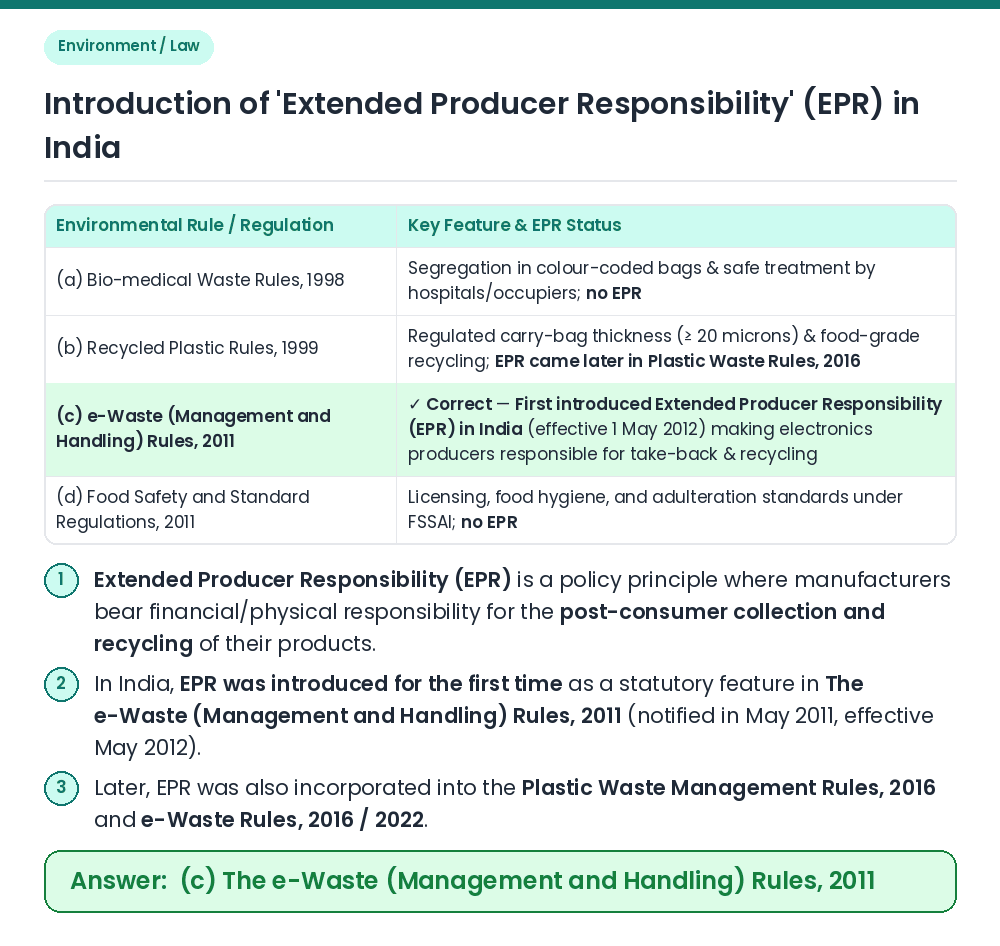
Answer: (C) The e-Waste (Management and Handling) Rules, 2011
Given / Concept: Extended Producer Responsibility (EPR) is an environmental policy approach (coined by Thomas Lindhqvist in 1990) under which a producer's responsibility for a product is extended to the post-consumer stage of its life cycle. Tracing EPR in Indian Law: In India, Extended Producer Responsibility (EPR) was introduced for the very first time in the e-Waste (Management and Handling) Rules, 2011 (notified under the Environment Protection Act, 1986, effective from 1 May 2012) (Option c ✓). Eliminating Other Options: Neither the Bio-medical Waste Rules, 1998 nor the Recycled Plastic Rules, 1999 contained EPR (EPR for plastics was introduced later in the Plastic Waste Management Rules, 2016). Result: Extended producer responsibility was introduced in The e-Waste (Management and Handling) Rules, 2011. Related Facts: • Mechanism under 2011 Rules: Producers of electrical and electronic equipment (EEE) were mandated to set up collection centres or take-back systems and channelize e-waste to authorized dismantlers/recyclers. • Subsequent Expansion of EPR: Now applies to e-Waste (2016 & 2022 Rules), Plastic Packaging (2016 & 2022 Rules), Battery Waste (2022), Waste Tyres (2022), and Used Oil. Correct Answer: (c) The e-Waste (Management and Handling) Rules, 2011