Civil Services Examination · Question 80
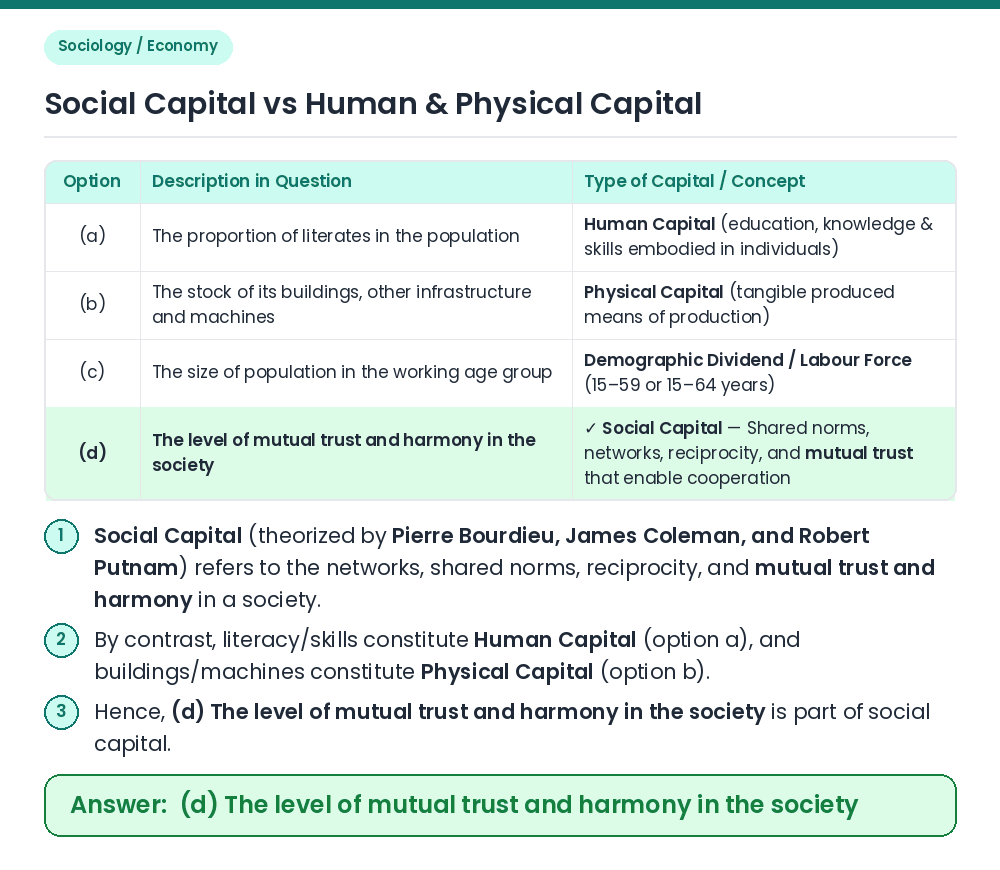
In the context of any country, which one of the following would be considered as part of its social capital?
Show answer & explanationShow explanation
Answer: (D) The level of mutual trust and harmony in the society
Given / Concept: In economics and sociology, total national wealth depends on Physical Capital, Human Capital, Natural Capital, and Social Capital. Distinguishing Capital Types: ⇒ Option (a): Literacy, education, and health represent Human Capital. ⇒ Option (b): Buildings, roads, infrastructure, and machinery represent Physical (Manufactured) Capital. ⇒ Option (c): Working-age population represents the Labour Force / Demographic potential. ⇒ Option (d): Social Capital refers to interpersonal networks, shared civic norms, social cohesion, and the level of mutual trust and harmony in society that lower transaction costs and facilitate collective action (Option d ✓). Result: The level of mutual trust and harmony in the society is considered part of a country's social capital. Related Facts: • Key Thinkers on Social Capital: Robert Putnam ('Bowling Alone' — bonding vs bridging social capital), Pierre Bourdieu, James Coleman, and Francis Fukuyama ('Trust'). • Economic Benefit: High social capital (trust) reduces contract enforcement costs, encourages investment, and strengthens democratic institutions. Correct Answer: (d) The level of mutual trust and harmony in the society