Civil Services Examination · Question 22
Passage–2 Many opportunities to harness the highly skewed, seasonal and spatial distribution of monsoon flows, which occur in a four-month period from June to September annually, have been lost. Since these few months account for most of the rainfall and consequent freshwater availability, the need for holding rainwater in reservoirs, for subsequently releasing it for use over the year, is a necessity nobody can afford to overlook. Climate change will continue to affect weather conditions and create water shortages and excesses. While millions suffer from droughts and floods, waters in the country's many rivers flow unutilized, and are discharged into the sea every year. With reference to the above passage, which of the following could be the most rational and practical implications for India? 1. Inter-linking of rivers should be undertaken. 2. A network of dams and canals should be built across the country for proper distribution of water. 3. Farmers should be provided easy loans for digging borewells. 4. Usage of water for agriculture should be regulated by law. 5. Distribution of river water among regions should be regulated by the Union Government. Select the correct answer using the code given below.
Show answer & explanationShow explanation
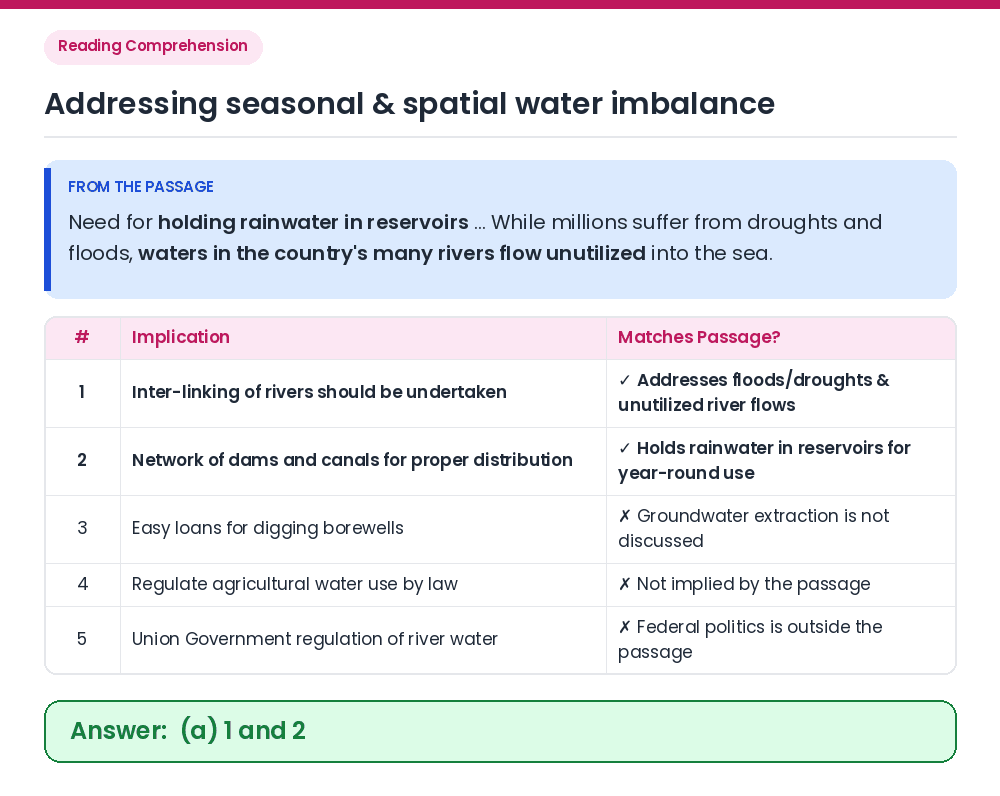
Answer: (A) 1 and 2
Given / Concept: The passage highlights two core problems: seasonal concentration of monsoon rain (requiring reservoirs) and spatial mismatch (simultaneous floods/droughts while river water flows unutilized into the sea). Evaluate 1 & 2: Inter-linking rivers (1) transfers surplus river water to drought-prone areas, and building dams/canals (2) stores rainwater in reservoirs for year-round distribution. Evaluate 3, 4 & 5: Borewell loans (3), agricultural water laws (4), and Union Government control (5) are not supported by the passage. Result: Statements 1 and 2 are the most rational and practical implications. Correct Answer: (a) 1 and 2