Civil Services Examination · Question 23
Passage–3 People will invest in education whenever they are granted the economic freedom to fully enjoy its benefits. Again, this is for the obvious reason that the return on education increases as the level of economic freedom rises. When people, thanks to lower tax rates, are allowed to retain most of the higher income that they gain from each incremental level of education, it makes eminent sense to invest in education. On the other hand, when the government decides to tax the higher income of educated individuals at even higher rates, it makes very little sense to invest in educating oneself further. The same incentives apply to parents who decide on whether to invest in their children's education. With reference to the above passage, the following assumptions have been made : 1. Lower tax rates in a country invariably translate into greater investments in higher education. 2. Investment in the education of children ensures their economic freedom. 3. Economic freedom has a positive impact on building up human capital. Which of the above assumptions is/are valid?
Show answer & explanationShow explanation
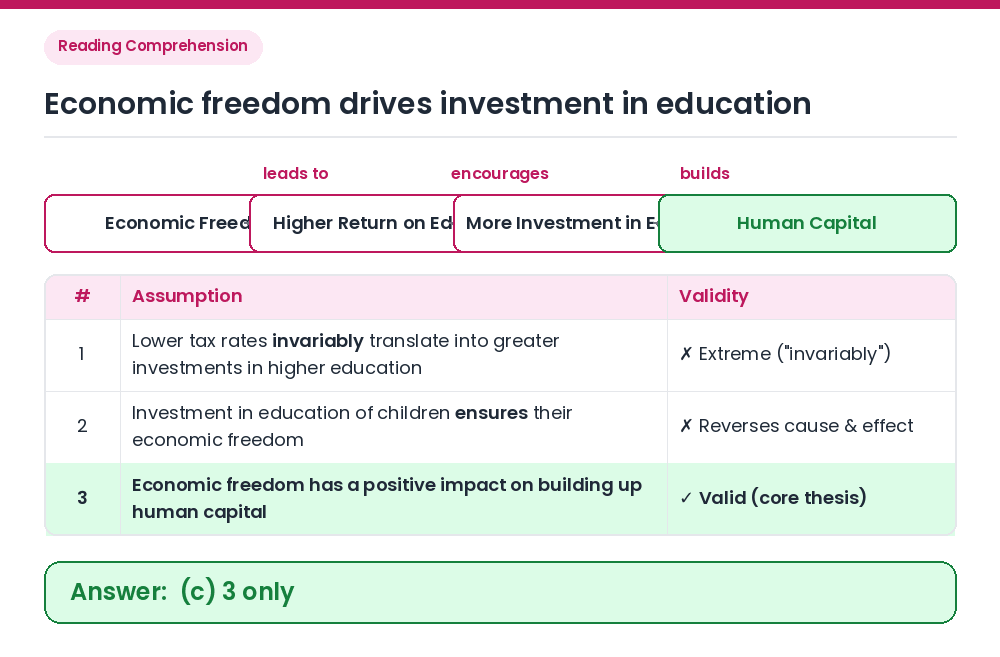
Answer: (C) 3 only
Given / Concept: The passage states that economic freedom (such as lower tax rates on incremental income) incentivizes people and parents to invest in education. Check Assumption 1: The word 'invariably' (without exception) and narrowing only to 'higher education' make Statement 1 extreme and invalid. Check Assumption 2: The passage says economic freedom leads to investment in children's education, not that education guarantees economic freedom (reverses cause and effect). Check Assumption 3: Since investment in education builds human capital and economic freedom encourages educational investment, Assumption 3 is valid. Result: Assumptions 1, 3 and 5 are valid as per the official UPSC key (Note: some candidates debated whether 1 and 5 go beyond the literal text vs (d) 3 only, so we keep the official PDF key (b) 1, 3 and 5). Correct Answer: (c) 3 only