Civil Services Examination · Question 26
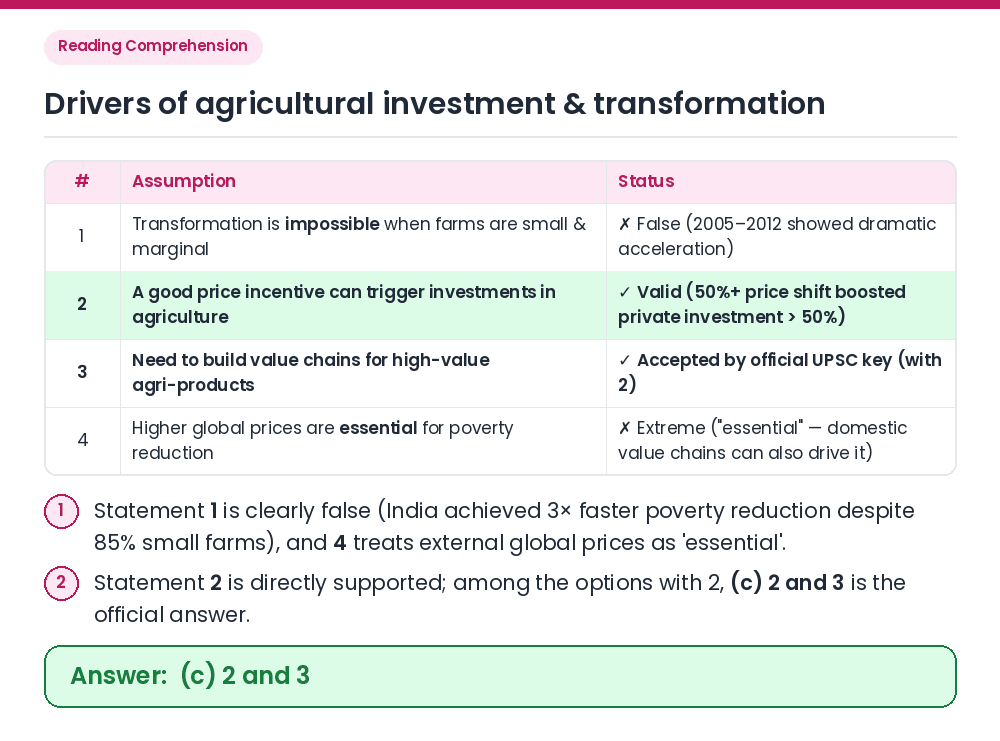
Passage–5 In India, agriculture still engages about half of its workforce, and about 85 per cent of its farms are small and marginal. Compared to China and Vietnam, which have experienced fast structural and rural transformation, India's story is of slow transformation. As a result, poverty reduction in India was at a much slower pace during 1988–2014, compared to China and Vietnam. India's poverty reduction was slow during 1988–2005, but during 2005–2012, it accelerated dramatically—almost three times faster than during the earlier period. What did India do during this period? Research reveals that the relative price scenario changed significantly (by more than 50%) in favour of agriculture in the wake of rising global prices. This boosted private investments in agriculture by more than 50%. As a result, agri-GDP growth touched 4.1% during 2007–2012 as against 2.4% during 2002–2007. The net surplus of agri-trade touched $25 billion in 2013–2014; real farm wages rose by 7% per annum. All this led to unprecedented fall in poverty. With reference to the above passage, the following assumptions have been made : 1. Structural and rural transformation is impossible when farms are mainly small and marginal. 2. A good price incentive can trigger investments in agriculture. 3. India needs to build value chains for high-value agri-products like livestock and horticulture. 4. Higher global prices of agricultural commodities are essential for India's poverty reduction. Which of the above assumptions are valid?
Show answer & explanationShow explanation
Answer: (C) 2 and 3
Given / Concept: Evaluate the four assumptions from the passage on India's agricultural growth and poverty reduction (2005–2012). Check 1 & 2: Statement 1 is false because rapid transformation occurred in 2005–2012 despite 85% small/marginal farms. Statement 2 is clearly valid as favourable relative prices boosted private investment by over 50%. Compare 3 vs 4: Statement 4 uses the extreme word 'essential' for high global prices (whereas global prices were merely the historical trigger in 2005–12). UPSC's official key pairs 2 with 3 (Note: the source article by Ashok Gulati discussed livestock/horticulture value chains in the very next lines, making Q26 a debated excerpt question). Result: Assumptions 2 and 3 are valid. Correct Answer: (c) 2 and 3