Civil Services Examination · Question 41
Passage–1 Spanish ships in the late 16th century first brought the potato tuber from South America to Europe whereby in the early 19th century, it had become a reliable backup to cereal crops, particularly in the cold, rain-soaked soils of Ireland. The Irish were soon almost wholly dependent on the potato as their staple food. And they were planting primarily one prodigious variety, the 'Lumper' potato, whose genetic frailty would be cruelly exposed by the fungus 'Phytophthora infestans'. In 1845, spores of the deadly fungus began spreading across the country, destroying nearly all the Lumpers in its path. The resulting famine killed or displaced millions. Which one of the following statements best reflects the critical message of the passage?
Show answer & explanationShow explanation
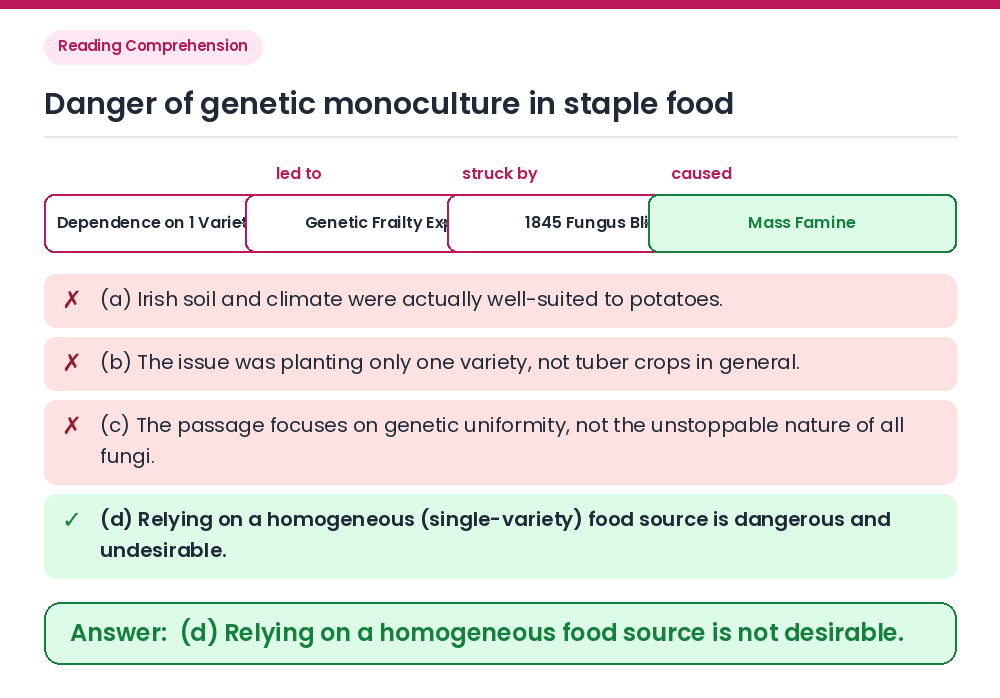
Answer: (D) Relying on a homogeneous food source is not desirable.
Given / Concept: Identify the core lesson from the 1845 Irish Potato Famine described in Passage 1. Passage Analysis: Ireland became almost wholly dependent on the potato and planted primarily a single genetically uniform variety ('Lumper'). Consequence of Monoculture: When the fungus Phytophthora infestans struck in 1845, the genetic frailty of this homogeneous crop destroyed nearly the entire food supply, causing a devastating famine. Result: Relying on a homogeneous food source is not desirable. Correct Answer: (d) Relying on a homogeneous food source is not desirable.