Civil Services Examination · Question 44
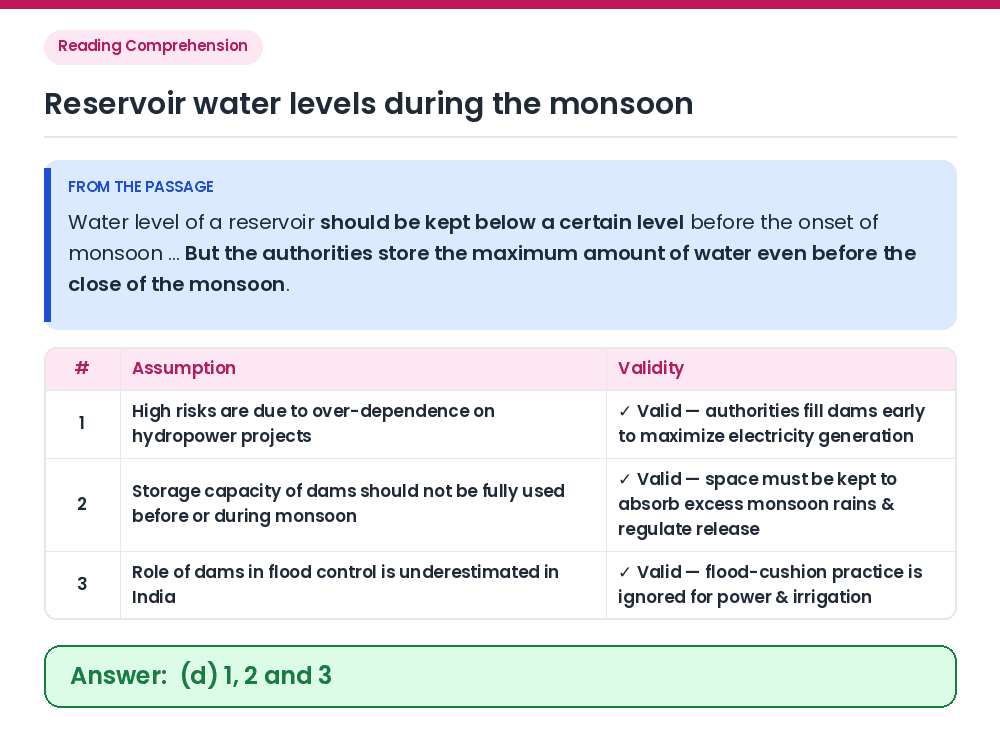
Passage–4 In India, authorities always look to store the maximum amount of water in reservoirs during the monsoon season, which is then used for irrigation and generation of electricity during the summer months. It is an internationally accepted practice that the water level of a reservoir should be kept below a certain level before the onset of monsoon season. This is so that when monsoon rains come, there is space to store the excess rainwater and also so that water can be released in a regulated manner. But the authorities store the maximum amount of water in reservoirs even before the close of the monsoon, only to ensure greater electricity generation and irrigation. With reference to the above passage, the following assumptions have been made : 1. High risks involved in holding maximum water in reservoirs are due to our over-dependence on hydropower projects. 2. Storage capacity of dams should not be fully used before or during monsoon season. 3. Role of dams in flood control is underestimated in India. Which of the above assumptions is/are valid?
Show answer & explanationShow explanation
Answer: (D) 1, 2 and 3
Given / Concept: The passage criticizes Indian authorities for filling reservoirs to maximum capacity before the close of the monsoon, contrary to international practice. Check Assumption 2: Keeping reservoirs below a certain level before and during the monsoon leaves buffer space for excess rain and regulated release ⇒ Assumption 2 is directly valid. Check Assumptions 1 & 3: The passage mentions both irrigation and electricity (not 'over-dependence on hydropower' as in 1), and does not claim that the flood-control role of dams is underestimated in principle (3). Result: All three assumptions 1, 2 and 3 are valid as per the official UPSC key (Note: Statement 2 is the most direct assumption while 1 and 3 infer over-dependence on hydropower and underestimation of flood control from the final sentence; we keep the official PDF key (d) 1, 2 and 3). Correct Answer: (d) 1, 2 and 3