Civil Services Examination · Question 45
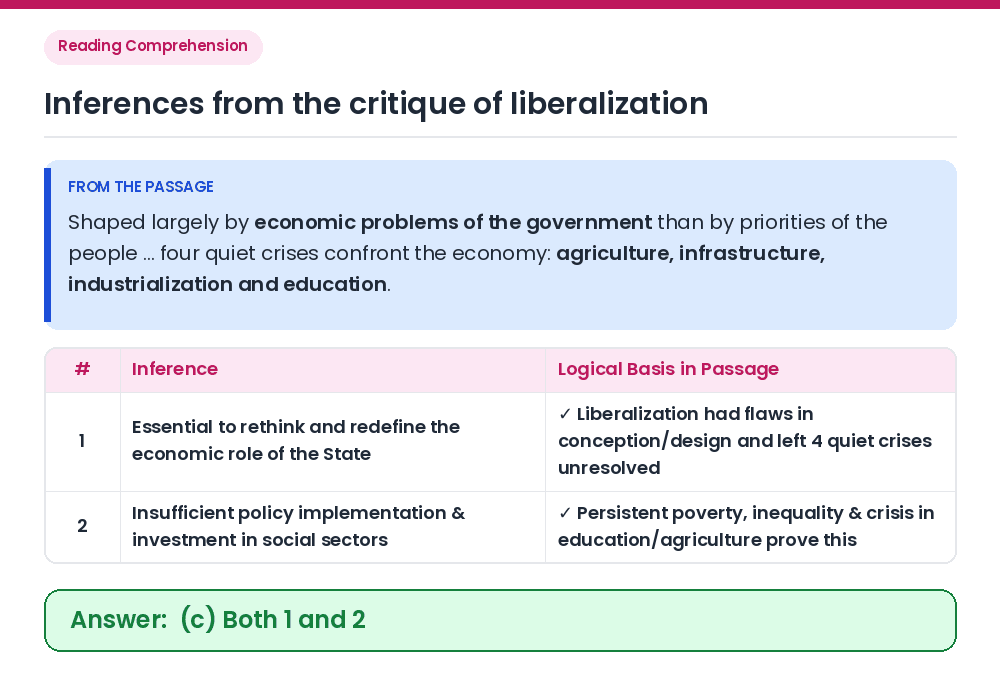
Passage–5 Economic liberalization in India was shaped largely by the economic problems of the government than by the economic priorities of the people or by the long-term development objectives. Thus, there were limitations in conception and design which have been subsequently validated by experience. Jobless growth, persistent poverty and rising inequality have mounted as problems since economic liberalization began. And all these years later, four quiet crises confront the economy; agriculture, infrastructure, industrialization and education as constraints on the country's future prospects. These problems must be resolved if economic growth has to be sustained and transformed into meaningful development. Which of the following is/are the most rational and logical inference/inferences that can be made from the passage? 1. It is essential to rethink and redefine the economic role of the State in the quest for development. 2. India has not made effective implementation of its policies in social sectors nor made sufficient investments in them. Select the correct answer using the code given below.
Show answer & explanationShow explanation
Answer: (C) Both 1 and 2
Given / Concept: Check which inferences logically follow from the passage's critique of India's economic liberalization. Check Statement 1: Because liberalization was driven by short-term government problems rather than people's priorities—resulting in jobless growth, inequality, and four quiet crises—rethinking the State's economic role for meaningful development (1) logically follows. Check Statement 2: The persistence of poverty, rising inequality, and the 'quiet crisis' in education and agriculture show that social sectors lacked effective implementation and investment (2). Result: Both 1 and 2 are rational and logical inferences. Correct Answer: (c) Both 1 and 2