Civil Services Examination · Question 23
Which of the following statements correctly explains the impact of Industrial Revolution on India during the first half of the nineteenth century?
Show answer & explanationShow explanation
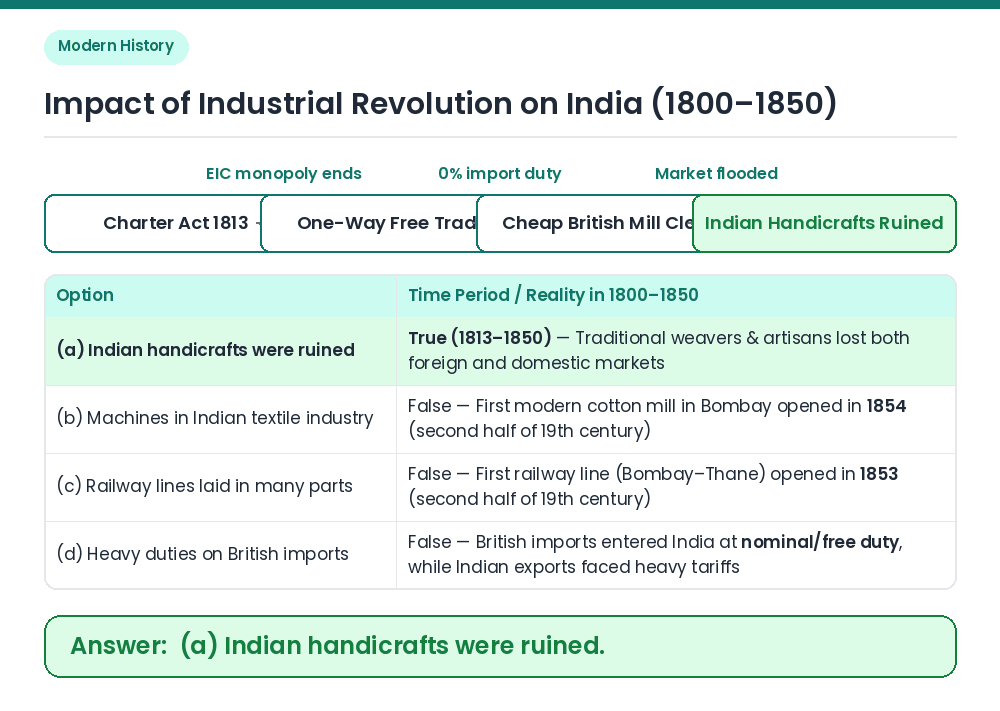
Answer: (A) Indian handicrafts were ruined.
Given / Concept: Economic impact of the British Industrial Revolution on India during the first half of the 19th century (1800–1850). Mechanism of Deindustrialisation: Following the Charter Act of 1813, Britain pursued a policy of 'one-way free trade'—flooding India with cheap, machine-made Manchester cotton textiles at minimal import duty while imposing heavy tariffs on Indian textiles in Britain. Eliminate Other Options: Indian cotton textile mills (1854) and Indian Railways (1853) both began in the second half of the 19th century, and British manufactures enjoyed near-zero import duties (not heavy duties). Result: Traditional Indian handicrafts were ruined during the first half of the 19th century. Related Facts: • Karl Marx's Observation: Noted that the British 'broke up the Indian handloom and destroyed the spinning-wheel', turning the homeland of cotton into an importer of cotton cloth. • First Cotton Mill in India: Set up by Cowasjee Nanabhoy Davar in Bombay in 1854. Correct Answer: (a) Indian handicrafts were ruined.