Civil Services Examination · Question 2
Passage—1 According to the Food and Agriculture Organization, one-third of food produced for human consumption is lost or wasted globally. Food is lost or wasted throughout the supply chain, from initial agricultural production to final household consumption. The increasing wastage also results in land degradation by about 45%, mainly due to deforestation, unsustainable agricultural practices, and excessive groundwater extraction. The energy spent over wasted food results in about 3.5 billion tonnes of carbon dioxide production every year. Decay also leads to harmful emissions of other gases in the atmosphere. Addressing the loss and wastage of food in all forms is critical to complete the cycle of food sufficiency and food sustainability. Based on the above passage, the following assumptions have been made : 1. The food distribution mechanism needs to be reimagined and made effective to reduce the loss and wastage of food. 2. Ensuring the reduction of wastage and loss of food is a social and moral responsibility of all citizens. Which of the assumptions given above is/are valid?
Show answer & explanationShow explanation
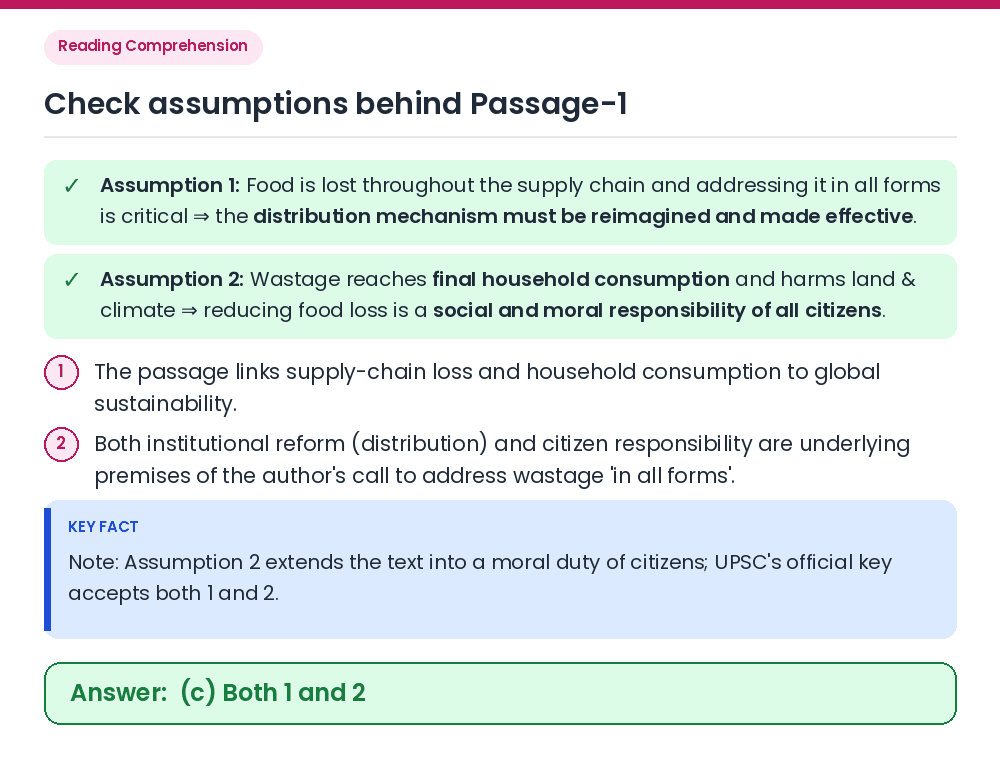
Answer: (C) Both 1 and 2
Given / Concept: An assumption is an unstated premise that supports the author's concluding call to address food loss 'in all forms' across the supply chain. Evaluate Assumption 1: Since food is lost throughout the supply chain, improving and reimagining the distribution mechanism is a valid underlying requirement ⇒ Assumption 1 is valid. Evaluate Assumption 2: Because wastage extends to 'final household consumption' and causes severe environmental damage, the author assumes collective civic and moral responsibility to curb it ⇒ Assumption 2 is treated as valid by the official key (though 'moral responsibility of all citizens' is slightly normative beyond the strict text). Result: Both assumptions 1 and 2 are valid. Correct Answer: (c) Both 1 and 2