Civil Services Examination · Question 3
Passage—2 As inflation rises, even governments previously committed to budget discipline are spending freely to help households. Higher interest rates announced by central banks are supposed to help produce modest fiscal austerity, because to maintain stable debts while paying more to borrow, governments must cut spending or raise taxes. Without the fiscal backup, monetary policy eventually loses traction. Higher interest rates become inflationary, not disinflationary, because they simply lead governments to borrow more to pay rising debt-service costs. The risk of monetary unmooring is greater when public debt rises, because interest rates become more important to budget deficits. Which of the following statements best reflects/reflect the most logical and rational inference/inferences that can be made from the passage? 1. Central banks cannot bring down inflation without budgetary backing. 2. The effects of monetary policy depend on the fiscal policies pursued by the government. Select the correct answer using the code given below.
Show answer & explanationShow explanation
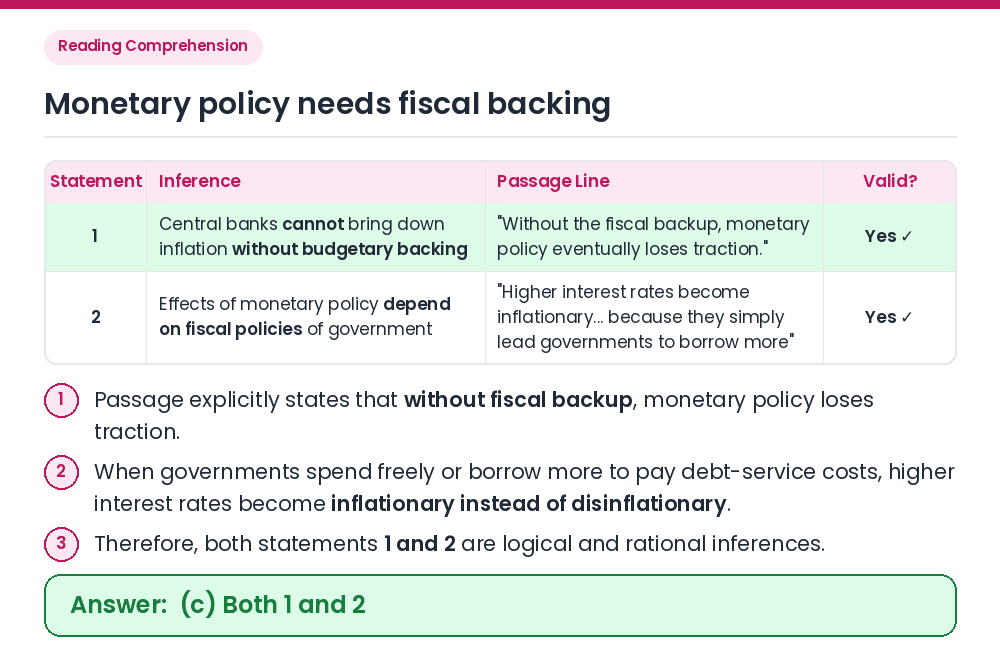
Answer: (C) Both 1 and 2
Given / Concept: The passage examines the interaction between central bank monetary policy (interest rates) and government fiscal policy (spending, taxes, debt). Evaluate Statement 1: The passage states, 'Without the fiscal backup, monetary policy eventually loses traction' and higher rates become inflationary ⇒ Central banks cannot curb inflation without budgetary backing (Statement 1 is true). Evaluate Statement 2: Whether higher interest rates reduce inflation or worsen it depends on whether the government cuts spending/raises taxes or borrows more ⇒ Monetary policy effects depend on fiscal policy (Statement 2 is true). Result: Both statements 1 and 2 follow logically. Correct Answer: (c) Both 1 and 2